Mentioned in:
Most Anticipated: The Great Winter 2025 Preview
It's cold, it's grey, its bleak—but winter, at the very least, brings with it a glut of anticipation-inducing books. Here you’ll find nearly 100 titles that we’re excited to cozy up with this season. Some we’ve already read in galley form; others we’re simply eager to devour based on their authors, subjects, or blurbs. We'd love for you to find your next great read among them.
The Millions will be taking a hiatus for the next few months, but we hope to see you soon.
—Sophia Stewart, editor
January
The Legend of Kumai by Shirato Sanpei, tr. Richard Rubinger (Drawn & Quarterly)
The epic 10-volume series, a touchstone of longform storytelling in manga now published in English for the first time, follows outsider Kamui in 17th-century Japan as he fights his way up from peasantry to the prized role of ninja. —Michael J. Seidlinger
The Life of Herod the Great by Zora Neale Hurston (Amistad)
In the years before her death in 1960, Hurston was at work on what she envisioned as a continuation of her 1939 novel, Moses, Man of the Mountain. Incomplete, nearly lost to fire, and now published for the first time alongside scholarship from editor Deborah G. Plant, Hurston’s final manuscript reimagines Herod, villain of the New Testament Gospel accounts, as a magnanimous and beloved leader of First Century Judea. —Jonathan Frey
Mood Machine by Liz Pelly (Atria)
When you eagerly posted your Spotify Wrapped last year, did you notice how much of what you listened to tended to sound... the same? Have you seen all those links to Bandcamp pages your musician friends keep desperately posting in the hopes that maybe, just maybe, you might give them money for their art? If so, this book is for you. —John H. Maher
My Country, Africa by Andrée Blouin (Verso)
African revolutionary Blouin recounts a radical life steeped in activism in this vital autobiography, from her beginnings in a colonial orphanage to her essential role in the continent's midcentury struggles for decolonization. —Sophia M. Stewart
The First and Last King of Haiti by Marlene L. Daut (Knopf)
Donald Trump repeatedly directs extraordinary animus towards Haiti and Haitians. This biography of Henry Christophe—the man who played a pivotal role in the Haitian Revolution—might help Americans understand why. —Claire Kirch
The Bewitched Bourgeois by Dino Buzzati, tr. Lawrence Venuti (NYRB)
This is the second story collection, and fifth book, by the absurdist-leaning midcentury Italian writer—whose primary preoccupation was war novels that blend the brutal with the fantastical—to get the NYRB treatment. May it not be the last. —JHM
Y2K by Colette Shade (Dey Street)
The recent Y2K revival mostly makes me feel old, but Shade's essay collection deftly illuminates how we got here, connecting the era's social and political upheavals to today. —SMS
Darkmotherland by Samrat Upadhyay (Penguin)
In a vast dystopian reimagining of Nepal, Upadhyay braids narratives of resistance (political, personal) and identity (individual, societal) against a backdrop of natural disaster and state violence. The first book in nearly a decade from the Whiting Award–winning author of Arresting God in Kathmandu, this is Upadhyay’s most ambitious yet. —JF
Metamorphosis by Ross Jeffery (Truborn)
From the author of I Died Too, But They Haven’t Buried Me Yet, a woman leads a double life as she loses her grip on reality by choice, wearing a mask that reflects her inner demons, as she descends into a hell designed to reveal the innermost depths of her grief-stricken psyche. —MJS
The Containment by Michelle Adams (FSG)
Legal scholar Adams charts the failure of desegregation in the American North through the story of the struggle to integrate suburban schools in Detroit, which remained almost completely segregated nearly two decades after Brown v. Board. —SMS
Death of the Author by Nnedi Okorafor (Morrow)
African Futurist Okorafor’s book-within-a-book offers interchangeable cover images, one for the story of a disabled, Black visionary in a near-present day and the other for the lead character’s speculative posthuman novel, Rusted Robots. Okorafor deftly keeps the alternating chapters and timelines in conversation with one another. —Nathalie op de Beeck
Open Socrates by Agnes Callard (Norton)
Practically everything Agnes Callard says or writes ushers in a capital-D Discourse. (Remember that profile?) If she can do the same with a study of the philosophical world’s original gadfly, culture will be better off for it. —JHM
Aflame by Pico Iyer (Riverhead)
Presumably he finds time to eat and sleep in there somewhere, but it certainly appears as if Iyer does nothing but travel and write. His latest, following 2023’s The Half Known Life, makes a case for the sublimity, and necessity, of silent reflection. —JHM
The In-Between Bookstore by Edward Underhill (Avon)
A local bookstore becomes a literal portal to the past for a trans man who returns to his hometown in search of a fresh start in Underhill's tender debut. —SMS
Good Girl by Aria Aber (Hogarth)
Aber, an accomplished poet, turns to prose with a debut novel set in the electric excess of Berlin’s bohemian nightlife scene, where a young German-born Afghan woman finds herself enthralled by an expat American novelist as her country—and, soon, her community—is enflamed by xenophobia. —JHM
The Orange Eats Creeps by Grace Krilanovich (Two Dollar Radio)
Krilanovich’s 2010 cult classic, about a runaway teen with drug-fueled ESP who searches for her missing sister across surreal highways while being chased by a killer named Dactyl, gets a much-deserved reissue. —MJS
Mona Acts Out by Mischa Berlinski (Liveright)
In the latest novel from the National Book Award finalist, a 50-something actress reevaluates her life and career when #MeToo allegations roil the off-off-Broadway Shakespearean company that has cast her in the role of Cleopatra. —SMS
Something Rotten by Andrew Lipstein (FSG)
A burnt-out couple leave New York City for what they hope will be a blissful summer in Denmark when their vacation derails after a close friend is diagnosed with a rare illness and their marriage is tested by toxic influences. —MJS
The Sun Won't Come Out Tomorrow by Kristen Martin (Bold Type)
Martin's debut is a cultural history of orphanhood in America, from the 1800s to today, interweaving personal narrative and archival research to upend the traditional "orphan narrative," from Oliver Twist to Annie. —SMS
We Do Not Part by Han Kang, tr. E. Yaewon and Paige Aniyah Morris (Hogarth)
Kang’s Nobel win last year surprised many, but the consistency of her talent certainly shouldn't now. The latest from the author of The Vegetarian—the haunting tale of a Korean woman who sets off to save her injured friend’s pet at her home in Jeju Island during a deadly snowstorm—will likely once again confront the horrors of history with clear eyes and clarion prose. —JHM
We Are Dreams in the Eternal Machine by Deni Ellis Béchard (Milkweed)
As the conversation around emerging technology skews increasingly to apocalyptic and utopian extremes, Béchard’s latest novel adopts the heterodox-to-everyone approach of embracing complexity. Here, a cadre of characters is isolated by a rogue but benevolent AI into controlled environments engineered to achieve their individual flourishing. The AI may have taken over, but it only wants to best for us. —JF
The Harder I Fight the More I Love You by Neko Case (Grand Central)
Singer-songwriter Case, a country- and folk-inflected indie rocker and sometime vocalist for the New Pornographers, takes her memoir’s title from her 2013 solo album. Followers of PNW music scene chronicles like Kathleen Hanna’s Rebel Girl and drummer Steve Moriarty’s Mia Zapata and the Gits will consider Case’s backstory a must-read. —NodB
The Loves of My Life by Edmund White (Bloomsbury)
The 85-year-old White recounts six decades of love and sex in this candid and erotic memoir, crafting a landmark work of queer history in the process. Seminal indeed. —SMS
Blob by Maggie Su (Harper)
In Su’s hilarious debut, Vi Liu is a college dropout working a job she hates, nothing really working out in her life, when she stumbles across a sentient blob that she begins to transform as her ideal, perfect man that just might resemble actor Ryan Gosling. —MJS
Sinkhole and Other Inexplicable Voids by Leyna Krow (Penguin)
Krow’s debut novel, Fire Season, traced the combustible destinies of three Northwest tricksters in the aftermath of an 1889 wildfire. In her second collection of short fiction, Krow amplifies surreal elements as she tells stories of ordinary lives. Her characters grapple with deadly viruses, climate change, and disasters of the Anthropocene’s wilderness. —NodB
Black in Blues by Imani Perry (Ecco)
The National Book Award winner—and one of today's most important thinkers—returns with a masterful meditation on the color blue and its role in Black history and culture. —SMS
Too Soon by Betty Shamieh (Avid)
The timely debut novel by Shamieh, a playwright, follows three generations of Palestinian American women as they navigate war, migration, motherhood, and creative ambition. —SMS
How to Talk About Love by Plato, tr. Armand D'Angour (Princeton UP)
With modern romance on its last legs, D'Angour revisits Plato's Symposium, mining the philosopher's masterwork for timeless, indispensable insights into love, sex, and attraction. —SMS
At Dark, I Become Loathsome by Eric LaRocca (Blackstone)
After Ashley Lutin’s wife dies, he takes the grieving process in a peculiar way, posting online, “If you're reading this, you've likely thought that the world would be a better place without you,” and proceeds to offer a strange ritual for those that respond to the line, equally grieving and lost, in need of transcendence. —MJS
February
No One Knows by Osamu Dazai, tr. Ralph McCarthy (New Directions)
A selection of stories translated in English for the first time, from across Dazai’s career, demonstrates his penchant for exploring conformity and society’s often impossible expectations of its members. —MJS
Mutual Interest by Olivia Wolfgang-Smith (Bloomsbury)
This queer love story set in post–Gilded Age New York, from the author of Glassworks (and one of my favorite Millions essays to date), explores on sex, power, and capitalism through the lives of three queer misfits. —SMS
Pure, Innocent Fun by Ira Madison III (Random House)
This podcaster and pop culture critic spoke to indie booksellers at a fall trade show I attended, regaling us with key cultural moments in the 1990s that shaped his youth in Milwaukee and being Black and gay. If the book is as clever and witty as Madison is, it's going to be a winner. —CK
Gliff by Ali Smith (Pantheon)
The Scottish author has been on the scene since 1997 but is best known today for a seasonal quartet from the late twenty-teens that began in 2016 with Autumn and ended in 2020 with Summer. Here, she takes the genre turn, setting two children and a horse loose in an authoritarian near future. —JHM
Land of Mirrors by Maria Medem, tr. Aleshia Jensen and Daniela Ortiz (D&Q)
This hypnotic graphic novel from one of Spain's most celebrated illustrators follows Antonia, the sole inhabitant of a deserted town, on a color-drenched quest to preserve the dying flower that gives her purpose. —SMS
Bibliophobia by Sarah Chihaya (Random House)
As odes to the "lifesaving power of books" proliferate amid growing literary censorship, Chihaya—a brilliant critic and writer—complicates this platitude in her revelatory memoir about living through books and the power of reading to, in the words of blurber Namwali Serpell, "wreck and redeem our lives." —SMS
Reading the Waves by Lidia Yuknavitch (Riverhead)
Yuknavitch continues the personal story she began in her 2011 memoir, The Chronology of Water. More than a decade after that book, and nearly undone by a history of trauma and the death of her daughter, Yuknavitch revisits the solace she finds in swimming (she was once an Olympic hopeful) and in her literary community. —NodB
The Dissenters by Youssef Rakha (Graywolf)
A son reevaluates the life of his Egyptian mother after her death in Rakha's novel. Recounting her sprawling life story—from her youth in 1960s Cairo to her experience of the 2011 Tahrir Square protests—a vivid portrait of faith, feminism, and contemporary Egypt emerges. —SMS
Tetra Nova by Sophia Terazawa (Deep Vellum)
Deep Vellum has a particularly keen eye for fiction in translation that borders on the unclassifiable. This debut from a poet the press has published twice, billed as the story of “an obscure Roman goddess who re-imagines herself as an assassin coming to terms with an emerging performance artist identity in the late-20th century,” seems right up that alley. —JHM
David Lynch's American Dreamscape by Mike Miley (Bloomsbury)
Miley puts David Lynch's films in conversation with literature and music, forging thrilling and unexpected connections—between Eraserhead and "The Yellow Wallpaper," Inland Empire and "mixtape aesthetics," Lynch and the work of Cormac McCarthy. Lynch devotees should run, not walk. —SMS
There's No Turning Back by Alba de Céspedes, tr. Ann Goldstein (Washington Square)
Goldstein is an indomitable translator. Without her, how would you read Ferrante? Here, she takes her pen to a work by the great Cuban-Italian writer de Céspedes, banned in the fascist Italy of the 1930s, that follows a group of female literature students living together in a Roman boarding house. —JHM
Beta Vulgaris by Margie Sarsfield (Norton)
Named for the humble beet plant and meaning, in a rough translation from the Latin, "vulgar second," Sarsfield’s surreal debut finds a seasonal harvest worker watching her boyfriend and other colleagues vanish amid “the menacing but enticing siren song of the beets.” —JHM
People From Oetimu by Felix Nesi, tr. Lara Norgaard (Archipelago)
The center of Nesi’s wide-ranging debut novel is a police station on the border between East and West Timor, where a group of men have gathered to watch the final of the 1998 World Cup while a political insurgency stirs without. Nesi, in English translation here for the first time, circles this moment broadly, reaching back to the various colonialist projects that have shaped Timor and the lives of his characters. —JF
Brother Brontë by Fernando A. Flores (MCD)
This surreal tale, set in a 2038 dystopian Texas is a celebration of resistance to authoritarianism, a mash-up of Olivia Butler, Ray Bradbury, and John Steinbeck. —CK
Alligator Tears by Edgar Gomez (Crown)
The High-Risk Homosexual author returns with a comic memoir-in-essays about fighting for survival in the Sunshine State, exploring his struggle with poverty through the lens of his queer, Latinx identity. —SMS
Theory & Practice by Michelle De Kretser (Catapult)
This lightly autofictional novel—De Krester's best yet, and one of my favorite books of this year—centers on a grad student's intellectual awakening, messy romantic entanglements, and fraught relationship with her mother as she minds the gap between studying feminist theory and living a feminist life. —SMS
The Lamb by Lucy Rose (Harper)
Rose’s cautionary and caustic folk tale is about a mother and daughter who live alone in the forest, quiet and tranquil except for the visitors the mother brings home, whom she calls “strays,” wining and dining them until they feast upon the bodies. —MJS
Disposable by Sarah Jones (Avid)
Jones, a senior writer for New York magazine, gives a voice to America's most vulnerable citizens, who were deeply and disproportionately harmed by the pandemic—a catastrophe that exposed the nation's disregard, if not outright contempt, for its underclass. —SMS
No Fault by Haley Mlotek (Viking)
Written in the aftermath of the author's divorce from the man she had been with for 12 years, this "Memoir of Romance and Divorce," per its subtitle, is a wise and distinctly modern accounting of the end of a marriage, and what it means on a personal, social, and literary level. —SMS
Enemy Feminisms by Sophie Lewis (Haymarket)
Lewis, one of the most interesting and provocative scholars working today, looks at certain malignant strains of feminism that have done more harm than good in her latest book. In the process, she probes the complexities of gender equality and offers an alternative vision of a feminist future. —SMS
Lion by Sonya Walger (NYRB)
Walger—an successful actor perhaps best known for her turn as Penny Widmore on Lost—debuts with a remarkably deft autobiographical novel (published by NYRB no less!) about her relationship with her complicated, charismatic Argentinian father. —SMS
The Voices of Adriana by Elvira Navarro, tr. Christina MacSweeney (Two Lines)
A Spanish writer and philosophy scholar grieves her mother and cares for her sick father in Navarro's innovative, metafictional novel. —SMS
Autotheories ed. Alex Brostoff and Vilashini Cooppan (MIT)
Theory wonks will love this rigorous and surprisingly playful survey of the genre of autotheory—which straddles autobiography and critical theory—with contributions from Judith Butler, Jamieson Webster, and more.
Fagin the Thief by Allison Epstein (Doubleday)
I enjoy retellings of classic novels by writers who turn the spotlight on interesting minor characters. This is an excursion into the world of Charles Dickens, told from the perspective iconic thief from Oliver Twist. —CK
Crush by Ada Calhoun (Viking)
Calhoun—the masterful memoirist behind the excellent Also A Poet—makes her first foray into fiction with a debut novel about marriage, sex, heartbreak, all-consuming desire. —SMS
Show Don't Tell by Curtis Sittenfeld (Random House)
Sittenfeld's observations in her writing are always clever, and this second collection of short fiction includes a tale about the main character in Prep, who visits her boarding school decades later for an alumni reunion. —CK
Right-Wing Woman by Andrea Dworkin (Picador)
One in a trio of Dworkin titles being reissued by Picador, this 1983 meditation on women and American conservatism strikes a troublingly resonant chord in the shadow of the recent election, which saw 45% of women vote for Trump. —SMS
The Talent by Daniel D'Addario (Scout)
If your favorite season is awards, the debut novel from D'Addario, chief correspondent at Variety, weaves an awards-season yarn centering on five stars competing for the Best Actress statue at the Oscars. If you know who Paloma Diamond is, you'll love this. —SMS
Death Takes Me by Cristina Rivera Garza, tr. Sarah Booker and Robin Myers (Hogarth)
The Pulitzer winner’s latest is about an eponymously named professor who discovers the body of a mutilated man with a bizarre poem left with the body, becoming entwined in the subsequent investigation as more bodies are found. —MJS
The Strange Case of Jane O. by Karen Thompson Walker (Random House)
Jane goes missing after a sudden a debilitating and dreadful wave of symptoms that include hallucinations, amnesia, and premonitions, calling into question the foundations of her life and reality, motherhood and buried trauma. —MJS
Song So Wild and Blue by Paul Lisicky (HarperOne)
If it weren’t Joni Mitchell’s world with all of us just living in it, one might be tempted to say the octagenarian master songstress is having a moment: this memoir of falling for the blue beauty of Mitchell’s work follows two other inventive books about her life and legacy: Ann Powers's Traveling and Henry Alford's I Dream of Joni. —JHM
Mornings Without Mii by Mayumi Inaba, tr. Ginny Tapley (FSG)
A woman writer meditates on solitude, art, and independence alongside her beloved cat in Inaba's modern classic—a book so squarely up my alley I'm somehow embarrassed. —SMS
True Failure by Alex Higley (Coffee House)
When Ben loses his job, he decides to pretend to go to work while instead auditioning for Big Shot, a popular reality TV show that he believes might be a launchpad for his future successes. —MJS
March
Woodworking by Emily St. James (Crooked Reads)
Those of us who have been reading St. James since the A.V. Club days may be surprised to see this marvelous critic's first novel—in this case, about a trans high school teacher befriending one of her students, the only fellow trans woman she’s ever met—but all the more excited for it. —JHM
Optional Practical Training by Shubha Sunder (Graywolf)
Told as a series of conversations, Sunder’s debut novel follows its recently graduated Indian protagonist in 2006 Cambridge, Mass., as she sees out her student visa teaching in a private high school and contriving to find her way between worlds that cannot seem to comprehend her. Quietly subversive, this is an immigration narrative to undermine the various reductionist immigration narratives of our moment. —JF
Love, Queenie by Mayukh Sen (Norton)
Merle Oberon, one of Hollywood's first South Asian movie stars, gets her due in this engrossing biography, which masterfully explores Oberon's painful upbringing, complicated racial identity, and much more. —SMS
The Age of Choice by Sophia Rosenfeld (Princeton UP)
At a time when we are awash with options—indeed, drowning in them—Rosenfeld's analysis of how our modingn idea of "freedom" became bound up in the idea of personal choice feels especially timely, touching on everything from politics to romance. —SMS
Sucker Punch by Scaachi Koul (St. Martin's)
One of the internet's funniest writers follows up One Day We'll All Be Dead and None of This Will Matter with a sharp and candid collection of essays that sees her life go into a tailspin during the pandemic, forcing her to reevaluate her beliefs about love, marriage, and what's really worth fighting for. —SMS
The Mysterious Disappearance of the Marquise of Loria by José Donoso, tr. Megan McDowell (New Directions)
The ever-excellent McDowell translates yet another work by the influential Chilean author for New Directions, proving once again that Donoso had a knack for titles: this one follows up 2024’s behemoth The Obscene Bird of Night. —JHM
Remember This by Anthony Giardina (FSG)
On its face, it’s another book about a writer living in Brooklyn. A layer deeper, it’s a book about fathers and daughters, occupations and vocations, ethos and pathos, failure and success. —JHM
Ultramarine by Mariette Navarro (Deep Vellum)
In this metaphysical and lyrical tale, a captain known for sticking to protocol begins losing control not only of her crew and ship but also her own mind. —MJS
We Tell Ourselves Stories by Alissa Wilkinson (Liveright)
Amid a spate of new books about Joan Didion published since her death in 2021, this entry by Wilkinson (one of my favorite critics working today) stands out for its approach, which centers Hollywood—and its meaning-making apparatus—as an essential key to understanding Didion's life and work. —SMS
Seven Social Movements that Changed America by Linda Gordon (Norton)
This book—by a truly renowned historian—about the power that ordinary citizens can wield when they organize to make their community a better place for all could not come at a better time. —CK
Mothers and Other Fictional Characters by Nicole Graev Lipson (Chronicle Prism)
Lipson reconsiders the narratives of womanhood that constrain our lives and imaginations, mining the canon for alternative visions of desire, motherhood, and more—from Kate Chopin and Gwendolyn Brooks to Philip Roth and Shakespeare—to forge a new story for her life. —SMS
Goddess Complex by Sanjena Sathian (Penguin)
Doppelgängers have been done to death, but Sathian's examination of Millennial womanhood—part biting satire, part twisty thriller—breathes new life into the trope while probing the modern realities of procreation, pregnancy, and parenting. —SMS
Stag Dance by Torrey Peters (Random House)
The author of Detransition, Baby offers four tales for the price of one: a novel and three stories that promise to put gender in the crosshairs with as sharp a style and swagger as Peters’ beloved latest. The novel even has crossdressing lumberjacks. —JHM
On Breathing by Jamieson Webster (Catapult)
Webster, a practicing psychoanalyst and a brilliant writer to boot, explores that most basic human function—breathing—to address questions of care and interdependence in an age of catastrophe. —SMS
Unusual Fragments: Japanese Stories (Two Lines)
The stories of Unusual Fragments, including work by Yoshida Tomoko, Nobuko Takai, and other seldom translated writers from the same ranks as Abe and Dazai, comb through themes like alienation and loneliness, from a storm chaser entering the eye of a storm to a medical student observing a body as it is contorted into increasingly violent positions. —MJS
The Antidote by Karen Russell (Knopf)
Russell has quipped that this Dust Bowl story of uncanny happenings in Nebraska is the “drylandia” to her 2011 Florida novel, Swamplandia! In this suspenseful account, a woman working as a so-called prairie witch serves as a storage vault for her townspeople’s most troubled memories of migration and Indigenous genocide. With a murderer on the loose, a corrupt sheriff handling the investigation, and a Black New Deal photographer passing through to document Americana, the witch loses her memory and supernatural events parallel the area’s lethal dust storms. —NodB
On the Clock by Claire Baglin, tr. Jordan Stump (New Directions)
Baglin's bildungsroman, translated from the French, probes the indignities of poverty and service work from the vantage point of its 20-year-old narrator, who works at a fast-food joint and recalls memories of her working-class upbringing. —SMS
Motherdom by Alex Bollen (Verso)
Parenting is difficult enough without dealing with myths of what it means to be a good mother. I who often felt like a failure as a mother appreciate Bollen's focus on a more realistic approach to parenting. —CK
The Magic Books by Anne Lawrence-Mathers (Yale UP)
For that friend who wants to concoct the alchemical elixir of life, or the person who cannot quit Susanna Clark’s Jonathan Strange and Mr. Norrell, Lawrence-Mathers collects 20 illuminated medieval manuscripts devoted to magical enterprise. Her compendium includes European volumes on astronomy, magical training, and the imagined intersection between science and the supernatural. —NodB
Theft by Abdulrazak Gurnah (Riverhead)
The first novel by the Tanzanian-British Nobel laureate since his surprise win in 2021 is a story of class, seismic cultural change, and three young people in a small Tanzania town, caught up in both as their lives dramatically intertwine. —JHM
Twelve Stories by American Women, ed. Arielle Zibrak (Penguin Classics)
Zibrak, author of a delicious volume on guilty pleasures (and a great essay here at The Millions), curates a dozen short stories by women writers who have long been left out of American literary canon—most of them women of color—from Frances Ellen Watkins Harper to Zitkala-Ša. —SMS
I'll Love You Forever by Giaae Kwon (Holt)
K-pop’s sky-high place in the fandom landscape made a serious critical assessment inevitable. This one blends cultural criticism with memoir, using major artists and their careers as a lens through which to view the contemporary Korean sociocultural landscape writ large. —JHM
The Buffalo Hunter Hunter by Stephen Graham Jones (Saga)
Jones, the acclaimed author of The Only Good Indians and the Indian Lake Trilogy, offers a unique tale of historical horror, a revenge tale about a vampire descending upon the Blackfeet reservation and the manifold of carnage in their midst. —MJS
True Mistakes by Lena Moses-Schmitt (University of Arkansas Press)
Full disclosure: Lena is my friend. But part of why I wanted to be her friend in the first place is because she is a brilliant poet. Selected by Patricia Smith as a finalist for the Miller Williams Poetry Prize, and blurbed by the great Heather Christle and Elisa Gabbert, this debut collection seeks to turn "mistakes" into sites of possibility. —SMS
Perfection by Vicenzo Latronico, tr. Sophie Hughes (NYRB)
Anna and Tom are expats living in Berlin enjoying their freedom as digital nomads, cultivating their passion for capturing perfect images, but after both friends and time itself moves on, their own pocket of creative freedom turns boredom, their life trajectories cast in doubt. —MJS
Guatemalan Rhapsody by Jared Lemus (Ecco)
Jemus's debut story collection paint a composite portrait of the people who call Guatemala home—and those who have left it behind—with a cast of characters that includes a medicine man, a custodian at an underfunded college, wannabe tattoo artists, four orphaned brothers, and many more.
Pacific Circuit by Alexis Madrigal (MCD)
The Oakland, Calif.–based contributing writer for the Atlantic digs deep into the recent history of a city long under-appreciated and under-served that has undergone head-turning changes throughout the rise of Silicon Valley. —JHM
Barbara by Joni Murphy (Astra)
Described as "Oppenheimer by way of Lucia Berlin," Murphy's character study follows the titular starlet as she navigates the twinned convulsions of Hollywood and history in the Atomic Age.
Sister Sinner by Claire Hoffman (FSG)
This biography of the fascinating Aimee Semple McPherson, America's most famous evangelist, takes religion, fame, and power as its subjects alongside McPherson, whose life was suffused with mystery and scandal. —SMS
Trauma Plot by Jamie Hood (Pantheon)
In this bold and layered memoir, Hood confronts three decades of sexual violence and searches for truth among the wreckage. Kate Zambreno calls Trauma Plot the work of "an American Annie Ernaux." —SMS
Hey You Assholes by Kyle Seibel (Clash)
Seibel’s debut story collection ranges widely from the down-and-out to the downright bizarre as he examines with heart and empathy the strife and struggle of his characters. —MJS
James Baldwin by Magdalena J. Zaborowska (Yale UP)
Zaborowska examines Baldwin's unpublished papers and his material legacy (e.g. his home in France) to probe about the great writer's life and work, as well as the emergence of the "Black queer humanism" that Baldwin espoused. —CK
Stop Me If You've Heard This One by Kristen Arnett (Riverhead)
Arnett is always brilliant and this novel about the relationship between Cherry, a professional clown, and her magician mentor, "Margot the Magnificent," provides a fascinating glimpse of the unconventional lives of performance artists. —CK
Paradise Logic by Sophie Kemp (S&S)
The deal announcement describes the ever-punchy writer’s debut novel with an infinitely appealing appellation: “debauched picaresque.” If that’s not enough to draw you in, the truly unhinged cover should be. —JHM
[millions_email]
A Year in Reading: 2024
Welcome to the 20th (!) installment of The Millions' annual Year in Reading series, which gathers together some of today's most exciting writers and thinkers to share the books that shaped their year. YIR is not a collection of yearend best-of lists; think of it, perhaps, as an assemblage of annotated bibliographies. We've invited contributors to reflect on the books they read this year—an intentionally vague prompt—and encouraged them to approach the assignment however they choose.
In writing about our reading lives, as YIR contributors are asked to do, we inevitably write about our personal lives, our inner lives. This year, a number of contributors read their way through profound grief and serious illness, through new parenthood and cross-country moves. Some found escape in frothy romances, mooring in works of theology, comfort in ancient epic poetry. More than one turned to the wisdom of Ursula K. Le Guin. Many describe a book finding them just when they needed it.
Interpretations of the assignment were wonderfully varied. One contributor, a music critic, considered the musical analogs to the books she read, while another mapped her reads from this year onto constellations. Most people's reading was guided purely by pleasure, or else a desire to better understand events unfolding in their lives or larger the world. Yet others centered their reading around a certain sense of duty: this year one contributor committed to finishing the six Philip Roth novels he had yet to read, an undertaking that he likens to “eating a six-pack of paper towels.” (Lucky for us, he included in his essay his final ranking of Roth's oeuvre.)
The books that populate these essays range widely, though the most commonly noted title this year was Tony Tulathimutte’s story collection Rejection. The work of newly minted National Book Award winner Percival Everett, particularly his acclaimed novel James, was also widely read and written about. And as the genocide of Palestinians in Gaza enters its second year, many contributors sought out Isabella Hammad’s searing, clear-eyed essay Recognizing the Stranger.
Like so many endeavors in our chronically under-resourced literary community, Year in Reading is a labor of love. The Millions is a one-person editorial operation (with an invaluable assist from SEO maven Dani Fishman), and producing YIR—and witnessing the joy it brings contributors and readers alike—has been the highlight of my tenure as editor. I’m profoundly grateful for the generosity of this year’s contributors, whose names and entries will be revealed below over the next three weeks, concluding on Wednesday, December 18. Be sure to subscribe to The Millions’ free newsletter to get the week’s entries sent straight to your inbox each Friday.
—Sophia Stewart, editor
Becca Rothfeld, author of All Things Are Too Small
Carvell Wallace, author of Another Word for Love
Charlotte Shane, author of An Honest Woman
Brianna Di Monda, writer and editor
Nell Irvin Painter, author of I Just Keep Talking
Carrie Courogen, author of Miss May Does Not Exist
Ayşegül Savaş, author of The Anthropologists
Zachary Issenberg, writer
Tony Tulathimutte, author of Rejection
Ann Powers, author of Traveling: On the Path of Joni Mitchell
Lidia Yuknavitch, author of Reading the Waves
Nicholas Russell, writer and critic
Daniel Saldaña París, author of Planes Flying Over a Monster
Lili Anolik, author of Didion and Babitz
Deborah Ghim, editor
Emily Witt, author of Health and Safety
Nathan Thrall, author of A Day in the Life of Abed Salama
Lena Moses-Schmitt, author of True Mistakes
Jeremy Gordon, author of See Friendship
John Lee Clark, author of Touch the Future
Ellen Wayland-Smith, author of The Science of Last Things
Edwin Frank, publisher and author of Stranger Than Fiction
Sophia Stewart, editor of The Millions
A Year in Reading Archives: 2023, 2022, 2021, 2020, 2019, 2018, 2017, 2016, 2015, 2014, 2013, 2011, 2010, 2009, 2008, 2007, 2006, 2005
Tuesday New Release Day: Rushdie; Williams; Oates; Evison; Powell; Rash
New this week: Two Years Eight Months and Twenty-Eight Nights by Salman Rushdie; The Visiting Privilege by Joy Williams; The Lost Landscape by Joyce Carol Oates; This is Your Life, Harriet Chance! by Jonathan Evison; Cries for Help, Various by Padgett Powell; and Above the Waterfall by Ron Rash. For more on these and other new titles, check out our Great Second-Half 2015 Book Preview.
Most Anticipated: The Great Second-Half 2015 Book Preview
If you like to read, we've got some news for you. The second-half of 2015 is straight-up, stunningly chock-full of amazing books. If someone told you, "Hey, there are new books coming out by Margaret Atwood, Lauren Groff, Elena Ferrante, John Banville, and Jonathan Franzen this year," you might say, "Wow, it's going to be a great year for books." Well, those five authors all have books coming out in September this year (alongside 22 other books we're highlighting that month). This year, you'll also see new books from David Mitchell, Bonnie Jo Campbell, Aleksandar Hemon, Patti Smith, Colum McCann, Paul Murray, and what we think is now safe to call a hugely anticipated debut novel from our own Garth Risk Hallberg.
The list that follows isn’t exhaustive -- no book preview could be -- but, at 9,100 words strong and encompassing 82 titles, this is the only second-half 2015 book preview you will ever need. Scroll down and get started.
July:
Go Set a Watchman by Harper Lee: Fifty-five years after the publication of Lee's classic To Kill a Mockingbird, this “newly discovered” sequel picks up 20 years after the events of the first novel when Jean Louise Finch -- better known to generations of readers as Scout -- returns to Maycomb, Ala., to visit her lawyer father, Atticus. Controversy has dogged this new book as many have questioned whether the famously silent Lee, now pushing 90 and in poor health, truly wanted publication for this long-abandoned early effort to grapple with the characters and subject matter that would evolve into her beloved coming-of-age novel. (Michael)
Between the World and Me by Ta-Nehisi Coates: A journalist who learned the ropes from David Carr, Coates is one of our most incisive thinkers and writers on matters of race. Coates is unflinching when writing of the continued racial injustice in the United States: from growing up in Baltimore and its culture of violence that preceded the Freddie Gray riots, to making the case for reparations while revealing the systematic racism embedded in Chicago real estate, to demanding that South Carolina stop flying the Confederate flag. In Between the World and Me, Coates grapples with how to inhabit a black body and how to reckon with America’s fraught racial history from a more intimate perspective -- in the form of a letter to his adolescent son. Given the current state of affairs, this book should be required reading. Originally slated for September, the book was moved up to July. Spiegel & Grau Executive Editor Chris Jackson said, "We started getting massive requests from people [for advance copies.] It spoke to this moment. We started to feel pregnant with this book. We had this book that so many people wanted." Publishers Weekly's review dispensed with any coyness, saying, "This is a book that will be hailed as a classic of our time." (Anne)
A Cure for Suicide by Jesse Ball: Elegant and spooky, dystopian and poetic, Jesse Ball’s follow-up to the well-reviewed Silence Once Begun follows a man known only as “the claimant” as he relearns everything under the guidance of an “examiner,” a woman who defines everything from the objects in their house to how he understands his existence. Then he meets another woman at a party and begins to question everything anew. A puzzle, a love story, and a tale of illness, memory, and manipulation, A Cure for Suicide promises to be a unique novel from a writer already known for his originality. (Kaulie)
The Dying Grass by William T. Vollmann: Volume number five of Vollmann’s Seven Dreams series expands on the author's epic portrayal of the settlement of North America. In his latest, Vollmann depicts the Nez Perce War, a months-long conflict in 1877 that saw the eponymous Native American tribe defend their mountain territories from encroachment by the U.S. Army. According to Vollmann, who spoke with Tom Bissell about the series for a New Republic piece, the text consists of mostly dialogue. (Thom)
Armada by Ernest Cline: Billy Mitchell, the “greatest arcade-video-game player of all time,” devoted 40 hours a week to the perfection of his craft, but he says he never skipped school or missed work. That was 35 years ago, before video games exploded not only in size and complexity, but also in absorptive allure. Recently, things have changed. It was only a year ago that a California couple was imprisoned for locking their children in a dingy trailer so the two of them could play 'World of Warcraft" uninterrupted. (By comparison, Mitchell’s devotion seems pedestrian.) This year, programmers are working on "No Man’s Sky," a “galaxy-sized video game” that’ll allow players to zip around a full-scale universe in the name of interplanetary exploration. It sounds impossibly gigantic. And with escalation surely comes a reckoning: Why are people spending more time with games than without? Across the world, a new class of professional gamers are earning lucrative sponsorships and appearing on slickly produced televised tournaments with tuition-sized purses. But surely more than money is at stake. (Full disclosure: I made more real money selling virtual items in "Diablo III’s" online marketplace than I did from writing in '12.) As increasingly rich worlds draw us in, what are we hoping to gain? It can’t just be distraction, can it? Are there practical benefits, or are we just hoping there are? This, to me, sounds like the heart of Ernest Cline’s latest novel, Armada, which focuses on a real life alien invasion that can only be stopped by gamers who’ve been obediently (albeit unknowingly) training for this very task. (Nick M.)
The Small Backs of Children by Lidia Yuknavitch: The visionary editor of Chiasmus Press and first to publish books by Kate Zambreno and Lily Hoang is herself a fierce and passionate writer. Yuknavitch is the author of a gutsy memoir, The Chronology of Water, and Dora: A Headcase, a fictional re-spinning of the Freudian narrative. Her new novel, Small Backs of Children, deals with art, violence, and the very real effects of witnessing violence and conflict through the media. According to Porochista Khakpour, the novel achieves “moments of séance with writers like Jean Rhys and Clarice Lispector,” a recommendation destined to make many a reader slaver. (Anne)
Lovers on All Saints’ Day by Juan Gabriel Vásquez: The Colombian writer Juan Gabriel Vásquez has been compared to Gabriel García Márquez and Roberto Bolaño. Winner of the International IMPAC Dublin Award for his novel The Sound of Things Falling, Vásquez is bringing out a collection of seven short stories never before published in English (nimbly translated from the Spanish by Anne McLean). The twinned themes of this collection are love and memory, which Vásquez unspools through stories about love affairs, revenge, troubled histories -- whole lives and worlds sketched with a few deft strokes. Nobel laureate Mario Vargas Llosa has called Vásquez “one of the most original new voices of Latin American literature.” (Bill)
Among the Wild Mulattos and Other Tales by Tom Williams: The recent passing of B.B. King makes Williams's previous book, Don't Start Me Talkin' -- a comic road novel about a pair of traveling blues musicians -- a timely read. His new story collection also skewers superficial discussions of race; admirers of James Alan McPherson will enjoy Williams's tragicomic sense. The book ranges from the hilarious “The Story of My Novel,” about an aspiring writer's book deal with Cousin Luther's Friend Chicken, to the surreal “Movie Star Entrances,” how one man's quest to remake himself with the help of an identity consulting company turns nefarious. Williams can easily, and forcefully, switch tragic, as in “The Lessons of Effacement.” When the main character is followed, he thinks “When your only offenses in life were drinking out of the juice carton and being born black in these United States, what could warrant such certain persecution?” Williams offers questions that are their own answers, as in the final story, when a biracial anthropologist discovers that a hidden mulatto community is more than simply legend. (Nick R.)
August:
Flood of Fire by Amitav Ghosh: Following Sea of Poppies (shortlisted for the Man Booker Prize) and River of Smoke, Calcutta-born Ghosh brings his Ibis Trilogy to a rousing conclusion with Flood of Fire. It’s 1839, and after China embargoes the lucrative trade of opium grown on British plantations in India, the colonial government sends an expeditionary force from Bengal to Hong Kong to reinstate it. In bringing the first Opium War to crackling life, Ghosh has illuminated the folly of our own failed war on drugs. Historical fiction doesn’t get any timelier than this. (Bill)
Fortune Smiles by Adam Johnson: Johnson is best known for his Pulitzer Prize-winning novel about North Korea, The Orphan Master’s Son, but he’s also the author of a terrific and off-kilter story collection called Emporium, a literary cousin to the sad-comic work of George Saunders, Sam Lipsyte, and Dan Chaon. This new collection of six stories, about everything from a former Stasi prison guard in East Germany to a computer programmer “finding solace in a digital simulacrum of the president of the United States,” echoes his early work while also building upon the ambition of his prize-winning tome. Kirkus gave the collection a starred review, calling it, “Bittersweet, elegant, full of hard-won wisdom.” (Edan)
Wind/Pinball by Haruki Murakami: A reissue of Murakami's first novels, Hear the Wind Sing and Pinball, 1973, which form the first half of the so-called (four-book) Trilogy of the Rat. Written in 1978 and 1980, these books were never published outside of Japan, evidently at Murakami's behest. He seems to have relented. (Lydia)
The State We’re In: Maine Stories by Ann Beattie: Fifteen stories -- connected by their depictions of a number of shared female characters – make up this new collection by short story master Beattie. In “Major Maybe,” which originally appeared in The New Yorker, two young roommates navigate Chelsea in the '80s. In “The Repurposed Barn,” readers glimpse an auction of Elvis Presley lamps, and in “Missed Calls,” a writer meets a photographer’s widow. Though most of the stories take place in Beattie’s home state of Maine, the author says they required her to call on the work of memory, as they took place in a “recalled” Maine rather than the Maine “outside her window.” (Thom)
The Marriage of Opposites by Alice Hoffman: Describing Rachel, the protagonist of Alice Hoffman’s 34th novel, as the mother of Camille Pissarro, the Father of Impressionism, feels like exactly the kind of thing I shouldn’t be doing right now. That’s because The Marriage of Opposites isn’t about an artist. It’s about the very real woman who led a full and interesting life of her own, albeit one that was profoundly shaped by decisions she didn’t make. Growing up in 19th-century St. Thomas, among a small community of Jewish refugees who’d fled the Inquisition, Rachel dreams of worlds she’s never known, like Paris. No doubt she yearns for a freedom she’s never known, too, after her father arranges her marriage to one of his business associates. What happens next involves a sudden death, a passionate affair, and an act of defiance signaling that perhaps Rachel is free, and that certainly she’s got her own story to tell. (Nick M.)
The Complete Stories by Clarice Lispector: For readers who worship at the altar of Lispector, the appearance of new work in translation is an event. Her writing has long been celebrated across her homeland, Brazil, and Latin America, but it wasn’t until recently that her name became common currency among English readers thanks to New Directions’s reissue of her novels and Benjamin Moser's notable biography. To add to the allure of “Brazil’s great mystic writer,” Moser offers, she was “that rare woman who looked like Marlene Dietrich and wrote like Virginia Woolf.” Calling the release of Lispector’s Complete Stories in English an “epiphany” in its promotional copy may sound like hyperbole. It’s not. (Anne)
Let Me Tell You: New Stories, Essays, and Other Writings by Shirley Jackson: Shirley Jackson has been a powerhouse in American fiction ever since her haunting 1948 short story “The Lottery,” which showcased her talent for turning the quotidian into something eerie and unnerving. Although she died 50 years ago, her family is still mining her archives for undiscovered gems, resulting in this new collection of 56 pieces, more than 40 of which have never been published before. From short stories to comic essays to drawings, Jackson’s full range is on display, yet her wit and sharp examination of social norms is present throughout. (Tess)
Three Moments of an Explosion by China Miéville: Miéville, the author of more than a dozen novels, is the sort of writer that deftly leaps across (often artificially-imposed) genre divides. He describes his corner of speculative fiction as “weird fiction,” in the footsteps of H.P. Lovecraft. (Tor.com mocked the desire to endlessly subcategorise genre by also placing his work in “New Weird!” “Fantastika!” “Literary Speculation!” “Hauntological Slipstream!” “Tentacular Metafusion!”) His first short story collection was published a decade ago; his second, with 10 previously-published stories and 18 new ones, is out in the U.S. in August. (Elizabeth)
The Daughters by Adrienne Celt: Celt, who is also a comics artist, writes in her bio that she grew up in Seattle, and has both worked for Google and visited a Russian prison. Her debut novel covers a lot of ground, emotionally and culturally: opera, Polish mythology, and motherhood/daughterhood. Kirkus has given The Daughters a starred review -- “haunting” and “psychologically nuanced” -- and she was a finalist for the Sherwood Anderson Fiction Award, among others. Celt’s web comics appear weekly here, and she sells t-shirts! One to watch.(Sonya)
Eileen by Ottessa Moshfegh: If anyone’s a Paris Review regular it’s Ottessa Moshfegh, with a coveted Plimpton Prize and four stories to her name (in only three year’s time). Her narrators have a knack for all kind of bad behavior: like the algebra teacher who imbibes 40s from the corner bodega on school nights, who smokes in bed and drunk dials her ex-husband, or the woman who offers to shoot a flock of birds for her apartment-manager boyfriend. Moshfegh’s novels track the lives of characters who are equally and indulgently inappropriate. Moshfegh’s first full-length novel Eileen follows a secretary at a boys prison (whose vices include a shoplifting habit) who becomes lured by friendship into committing a far larger crime. (Anne)
Shipbreaking by Robin Beth Schaer: Schaer worked as a deckhand on the HMS Bounty, which sank during Hurricane Sandy, so I entered Shipbreaking feeling that I would be in credible hands. I often read poetry to find phrases and lines to hold with me beyond the final page, and Schaer, who once wrote that “to leave the shore required surrender,” delivers. “I am / forgiven by water, but savaged by sky” says one narrator. Another: “Even swooning / is a kind of fainting, overwhelmed / by bliss, instead of pain.” Shipbreaking is a book about being saved while recognizing loss. Schaer’s words apply equally to marine and shore moments, as so often life is “a charade that only deepens / the absence it bends to hide.” Schaer’s long poems are especially notable; “Middle Flight” and “Natural History” remake pregnancy and motherhood: “Before now, he floated in dark water...Someday he too will chase his lost lightness / half-remembered toward the sky.” If we trust our poets enough, we allow them cause wounds and then apply the salves: “The world without us / is nameless.” (Nick R.)
Last Mass by Jamie Iredell: "I am a Catholic." So begins Iredell's book, part memoir about growing up Catholic in Monterey County, Calif., part historical reconsideration of Blessed Father Fray Juníperro Serra, an 18th-century Spanish Franciscan who will be canonized by Pope Francis later this year. Structured around the Stations of the Cross, Iredell's unique book reveals the multitudinous complexities of Catholic identity, and how the tensions between those strands are endemic to Catholic culture. Think of Last Mass as William Gass's On Being Blue recast as On Being Catholic: Iredell's range is encyclopedic without feeling stretched. Delivered in tight vignettes that capture the Catholic tendency to be simultaneously specific and universal, the book's heart is twofold. First, how faith is ultimately a concern of the flesh, as seen in the faithful’s reverence for the body of Christ and struggles over experiencing sexuality (Catholics pivot between the obscene and the divine without missing a step). Second, in documenting Catholic devotion to saintly apocrypha, Iredell carries the reader to his most heartfelt note: his devotion and love for his father and family. (Nick R.)
September:
Purity by Jonathan Franzen: Known for his mastery of the modern domestic drama and his disdain for Internet things, Franzen, with his latest enormous novel, broadens his scope from the tree-lined homes of the Midwest and the Mainline to variously grim and paradisiacal domiciles in Oakland, East Germany, and Bolivia; alters his tableaux from the suburban nuclear family to fractured, lonely little twosomes; and progresses from cat murder to human murder. The result is something odd and unexpected -- a political novel that is somehow less political than his family novels at their coziest, and shot through with new strains of bitterness. Expect thinkpieces. (Lydia)
Fates and Furies by Lauren Groff: Groff’s highly anticipated third novel follows married couple Lotto and Matthilde for over two decades, starting with an opening scene (published on The Millions), of the young, just-hitched duo getting frisky on the beach. The book was one of the galleys-to-grab at BookExpo America this spring, and it’s already received glowing reviews from Library Journal, Publishers Weekly, and Kirkus. Meg Wolitzer writes of Groff: “Because she's so vitally talented line for line and passage for passage, and because her ideas about the ways in which two people can live together and live inside each other, or fall away from each other, or betray each other, feel foundationally sound and true, Fates and Furies becomes a book to submit to, and be knocked out by, as I certainly was.” (Edan)
The Heart Goes Last by Margaret Atwood: A hotly anticipated story about “a near-future in which the lawful are locked up and the lawless roam free,” this is Atwood’s first standalone novel since The Blind Assassin, which won the Man Booker in 2000 (The Penelopiad was part of the Canongate Myth Series). Charmaine and Stan are struggling to make ends meet in the midst of social and economic turmoil. They strike a deal to join a “social experiment” that requires them to swap suburban paradise for their freedom. Given Atwood’s reputation for wicked social satire, I doubt it goes well. Publishers Weekly notes, "The novel is set in the same near-future universe as Atwood’s Positron series of four short stories, released exclusively as e-books. The most recent Positron installment, which was published under the same name as the upcoming novel, came out in 2013." (Claire)
The Blue Guitar by John Banville: Banville’s 16th novel takes its title from a Wallace Stevens poem about artistic imagination and perception: “Things as they are/ Are changed upon the blue guitar.” Banville’s protagonist, Oliver Otway Orme, is a talented but blocked painter, an adulterer, and something of a kleptomaniac who returns to his childhood home to ruminate on his misdeeds and vocation. With such an intriguing, morally suspect central character as his instrument, Banville should be able to play one of his typically beguiling tunes. (Matt)
The Story of the Lost Child by Elena Ferrante: Ferrante writes what James Wood called "case histories, full of flaming rage, lapse, failure, and tenuous psychic success." In the fourth and final of the reclusive global publishing sensation's Neapolitan novels, we return to Naples and to the tumultuous friendship of Lila Cerullo and Elena Greco. (Lydia)
Undermajordomo Minor by Patrick DeWitt: DeWitt’s second novel, The Sisters Brothers, was short-listed for the Man Booker and just about every Canadian prize going, and for good reason. It took the grit, melancholy, and wit of the Western genre and bent it just enough toward the absurd. This new work, billed as “a fable without a moral,” is about a young man named Lucien (Lucy) Minor who becomes an undermajordomo at a castle full of mystery, dark secrets, polite theft, and bitter heartbreak. Our own Emily St. John Mandel calls it, “unexpectedly moving story about love, home, and the difficulty of finding one’s place in the world.” (Claire)
Two Years Eight Months and Twenty-Eight Nights by Salman Rushdie: A new Rushdie novel is an event -- as is a new Rushdie tweet for that matter, especially after his vigorous defense of PEN’s decision to honor Charlie Hebdo. His latest follows the magically gifted descendants of a philosopher and a jinn, one of those seductive spirits who “emerge periodically to trouble and bless mankind.” These offspring are marshaled into service when a war breaks out between the forces of light and dark that lasts, you got it, two years, eight months, and 28 nights. You can read an excerpt at The New Yorker. (Matt)
Sweet Caress by William Boyd: Boyd is one of those Englishmen who changes hats as effortlessly as most people change socks. A novelist, screenwriter, playwright, and movie director, Boyd has been shortlisted for the Booker Prize (for 1982’s An Ice-Cream War), and he recently wrote the James Bond novel Solo. His new novel, Sweet Caress, is the story of Amory Clay, whose passion for photography takes her from London to Berlin in the decadent 1920s, New York in the turbulent '30s, and France during World War II, where she becomes one of the first female war photographers. This panoramic novel is illustrated with “found” period photographs. (Bill)
The Visiting Privilege: New and Collected Stories by Joy Williams: The “definitive” collection from an acknowledged mastress of the short story -- Rea Award Winner alongside Donald Barthelme, Alice Munro, Robert Coover, Deborah Eisenberg, James Salter, Mary Robison, Amy Hempel, et alia -- The Visiting Privilege collects 33 stories from three previous collections, and 13 stories previously unpublished in book form. Joy Williams has been a writer’s writer for decades, yet never goes out of fashion. Her stories are sometimes difficult, bizarre, upsetting even; and always funny, truthful, and affecting. Williams once exhorted student writers to write something “worthy, necessary; a real literature instead of the Botox escapist lit told in the shiny prolix comedic style that has come to define us.” Would-be writers perplexed by what is meant by an original “voice” should read Williams, absolutely. Read her in doses, perhaps, but read her, for godssakes. (Sonya)
Did You Ever Have a Family by Bill Clegg: By day, Clegg is a glamorous New York literary agent known for snagging fat book deals for literary authors like Matthew Thomas and Daniyal Mueenuddin. At night, he peels off the power suit and becomes a literary author himself, first with two memoirs about his descent into -- and back out of -- crack addiction, and now a debut novel. In Did You Ever Have a Family, tragedy strikes a middle-aged woman on the eve of her daughter’s wedding, setting her off on a journey across the country from Connecticut to the Pacific Northwest, where she hides out in a small beachside hotel. (Michael)
The Lost Landscape by Joyce Carol Oates: Volcanically prolific Oates has produced another memoir, The Lost Landscape: A Writer’s Coming of Age, which focuses on her formative years growing up on a hard-scrabble farm in upstate New York. We learn of young Oates’s close friendship with a red hen, her first encounters with death, and the revelation, on discovering Alice in Wonderland, that life offers endless adventures to those who know how to look for them. Witnessing the birth of this natural storyteller, we also witness her learning harsh lessons about work, sacrifice and loss -- what Oates has called “the difficulties, doubts and occasional despair of my experience.” (Bill)
The Double Life of Liliane by Lily Tuck: The only child of a German movie producer living in Italy and an artistic mother living in New York, Liliane also has ancestors as varied as Mary Queen of Scots, Moses Mendelssohn, and a Mexican adventurer. In this sixth, semi-autobiographical novel from Lily Tuck, winner of the National Book Award for The News from Paraguay, the imaginative Liliane uncovers her many ancestors, tracing and combining their histories as she goes. The result is a writerly coming-of-age that spans both World Wars, multiple continents, and all of one very diverse family. (Kaulie)
This is Your Life, Harriet Chance! by Jonathan Evison: A writer with a reputation for having a big heart takes on Harriet Chance who, at 79 years old and after the death of her husband, goes on a Alaskan cruise. Soon she discovers that she’s been living under false pretenses for the past 60 years. In other hands, this story might turn out as schmaltzy as the cruise ship singer, but Evison’s previous novels, The Revised Fundamentals of Caregiving, West of Here, and All About Lulu have established him as a master of the wistfully wise and humanely humorous. As Evison said in a recent interview, fiction is “an exercise in empathy.” (Claire)
Gold, Fame, Citrus, by Claire Vaye Watkins: Set in an increasingly plausible-seeming future in which drought has transformed Southern California into a howling wasteland, this debut novel by the author of the prize-winning story collection Battleborn finds two refugees of the water wars holed up in a starlet’s abandoned mansion in L.A.’s Laurel Canyon. Seeking lusher landscape, the pair head east, risking attack by patrolling authorities, roving desperadoes, and the unrelenting sun. (Michael)
Cries for Help, Various by Padgett Powell: Back when the working title for his new story collection was Cries for Help: Forty-Five Failed Novels, Padgett Powell proclaimed the book “unsalable.” He was wrong. It’s coming out as Cries for Help, Various, and it’s a reminder that with Padgett Powell, anything is possible. In “Joplin and Dickens,” for instance, the titular singer and writer meet as emotionally needy students in an American middle school. Surreal wackiness can’t disguise the fact that these 44 stories are grounded in such very real preoccupations as longing, loneliness, and cultural nostalgia. The authorial voice ranges from high to low, from cranky to tender. It’s the music of a virtuoso. (Bill)
The Marvels by Brian Selznick: You know a book is eagerly awaited when you witness an actual mob scene full of shoving and elbows for advance copies at BookExpo America. (In case there’s any doubt, I did witness this.) Selznick, the Caldecott-winning author and illustrator of dozens of children’s books, is best known for The Invention of Hugo Cabret, published in 2008. His newest work weaves together “two seemingly unrelated stories” told in two seemingly unrelated forms: a largely visual tale that begins with an 18th-century shipwreck, and a largely prose one that begins in London in 1990. (Elizabeth)
Scrapper by Matt Bell: Set in a re-imagined Detroit, Bell’s second novel follows Kelly, a “scrapper,” who searches for valuable materials in the city’s abandoned buildings. One day Kelly finds an orphaned boy, a discovery that forces Kelly to reexamine his own past and buried traumas. Advance reviews describe Scrapper as “harrowing” and “grim,” two adjectives that could also be used to describe Bell’s hypnotic debut, In the House Upon the Dirt Between the Lake and the Woods. (Hannah)
Above the Waterfall by Ron Rash: For his sixth novel, Ron Rash returns to the beautiful but unforgiving Appalachian hills that have nourished most of his fiction and poetry. In Above the Waterfall, a sheriff nearing retirement and a young park ranger seeking to escape her past come together in a small Appalachian town bedeviled by poverty and crystal meth. A vicious crime will plunge the unlikely pair into deep, treacherous waters. Rash, a 2009 PEN/Faulkner Award finalist, is one of our undisputed Appalachian laureates, in company with Robert Morgan, Lee Smith, Fred Chappell, and Mark Powell. He has called this “a book about wonder, about how nature might sustain us.” (Bill)
The Story of My Teeth by Valeria Luiselli: This young Mexican writer and translator was honored last year with a National Book Foundation “Five Under 35” Award for her 2013 debut, Faces in the Crowd. Her essay collection Sidewalks, published the same year, was also a critical favorite. Her second novel, The Story of My Teeth, is a story of stories, narrated by Gustavo “Highway” Sánchez Sánchez, a traveling auctioneer whose prize possession is a set of Marilyn Monroe’s dentures. Set in Mexico City, it was written in collaboration with Jumex Factory Staff -- which is a story in and of itself. (Hannah)
Marvel and a Wonder by Joe Meno: The author of Hairstyles of the Damned and The Boy Detective Fails has taken an ambitious turn with Marvel and a Wonder. The book follows a Korean War vet living with his 16-year-old grandson on a farm in southern Indiana. They are given a beautiful quarterhorse, an unexpected gift that transforms their lives, but when the horse is stolen they embark on a quest to find the thieves and put their lives back together. (Janet)
Under the Udala Trees by Chinelo Okparanta: Okparanta was born in Nigeria and raised as a Jehovah’s Witness. She emigrated to the United States at age 10, but her fiction often returns to Nigeria, painting a striking portrait of the contemporary nation. Her first book, the 2013 short story collection Happiness, Like Water, was shortlisted for many prizes and won the 2014 Lambda Literary Award for Lesbian Fiction. Her debut novel, Under the Udala Trees, tells the story of two young girls who fall in love against the backdrop of the Nigerian Civil War. (Elizabeth)
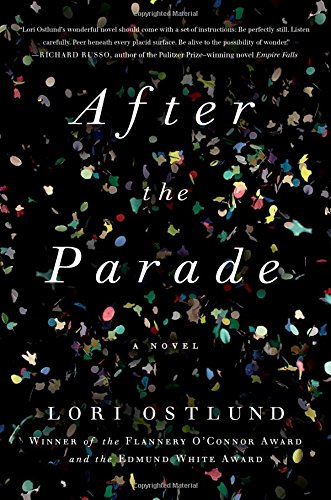
After the Parade by Lori Ostlund: This assured debut tells the story of Aaron, an ESL teacher who decides, at age 40, to leave his lifelong partner, the older man who “saved him” from his Midwestern hometown. But in order to move on, Aaron has to take a closer look at his Midwestern past and find out if there’s anything worth salvaging. Readers may know Ostlund from her award-winning 2010 short story collection, The Bigness of the World. (Hannah)
The Hundred Year Flood by Matthew Salesses: Like the titular flood that churns through the second half of the novel, The Hundred Year Flood is a story of displacement. Salesses, whose non-fiction examines adoption and identity, tells the story of Tee, a Korean-American living in Prague in late 2001. The attacks of 9/11 are not mere subtext in this novel; Tee’s uncle commits suicide by plane, and the entire novel dramatizes how the past binds our present. “Anywhere he went he was the only Asian in Prague,” but Tee soon finds friendship in Pavel, a painter made famous during the 1989 Velvet Revolution, and Katka, his wife. Tee becomes Pavel’s subject, and soon, Katka’s lover. “In the paintings, [Tee] was more real than life. His original self had been replaced:” Salesses novel dramatically documents how longing can turn, painfully, into love. (Nick R.)
Not on Fire, but Burning by Greg Hrbek: An explosion has destroyed San Francisco. Twelve-year-old Dorian and his parents have survived it, but where is his older sister, Skyler? She never existed, according to Dorian’s parents. Post-incident America is a sinister place, where Muslims have been herded onto former Native American reservations and parents deny the existence of a boy’s sister. According to the publisher, Hrbek’s sophomore novel is “unlike anything you've read before -- not exactly a thriller, not exactly sci-fi, not exactly speculative fiction, but rather a brilliant and absorbing adventure into the dark heart of...America.” Joining the Melville House family for his third book, Hrbek, whose story “Paternity” is in the current issue of Tin House, may be poised to be the next indie breakout. (Sonya)
Dryland by Sara Jaffe: Jaffe has lived many lives it seems, one as a guitarist for punk band Erase Errata, another as a founding editor of New Herring Press (which just reissued a bang-up edition of Lynne Tillman's Weird Fucks with paintings by Amy Sillman). Proof of Jaffe’s life as a fiction-writer can be found online, too, including gems like “Stormchasers.” This fall marks the publication of Jaffe’s first novel, Dryland, a coming-of-age tale set in the '90s that depicts a girl whose life is defined by absences, including and especially that of her not-talked about older brother, until she has a chance to find him and herself. (Anne)
Hotel and Vertigo by Joanna Walsh: British critic, journalist, and fiction writer Walsh kickstarted 2014 with the #readwomen hashtag phenomenon, declaring it the year to read only women. It seems that 2015 is the year to publish them, and specifically Walsh, who has two books coming out this fall. Hotel is “part memoir part meditation” that draws from Walsh’s experience as a hotel reviewer -- and that explores “modern sites of gathering and alienation.” The inimitable Dorothy Project will publish Vertigo, a book of loosely linked stories that channels George Perec and Christine Brooke-Rose, and which Amina Cain claims, “quietly subvert(s) the hell out of form.” (Anne)
October:
City on Fire by Garth Risk Hallberg: Garth is a contributing editor to the site, where he has written masterful essays over nearly a decade, while teaching and putting out his novella Field Guide to the North American Family. He is a keen and perfect reader of novels, and of critics -- he told us about Roberto Bolaño. We trust him to steer us through difficult books. (He is, additionally, a champion punner.) When his debut novel, a 900-pager written over six years, was purchased by Knopf, we felt not only that it couldn't happen to a nicer guy, but that it couldn't happen to a more serious, a more bona fide person of letters. City on Fire is the result of his wish to write a novel that took in "9/11, the 1977 blackout, punk rock, the fiscal crisis," which explains the 900 pages. Read the opening lines, evoking a modern Inferno, here. I think we're in for something special. (Lydia)
Slade House by David Mitchell: Slade House started out with “The Right Sort,” a short story Mitchell published via 280 tweets last summer as publicity for The Bone Clocks. That story, which was published in full, exclusively here at The Millions, is about a boy and his mother attending a party to which they’d received a mysterious invitation. The story “ambushed” him, said Mitchell, and, before he knew it, it was the seed of a full-fledged novel, seemingly about years of mysterious parties at the same residence that we can assume are connected to each other and to characters we’ve already met. The book is said to occupy the same universe as The Bone Clocks and, by extension, Mitchell’s increasingly interconnected body of work. (Janet)
M Train by Patti Smith: The follow-up to Just Kids, Smith’s much-beloved (and National Book Award-winning) 2010 memoir about her youthful friendship with the artist Robert Mapplethorpe as they made their way in 1960s New York City. In a recent interview, Smith said M Train is “not a book about the past so much. It’s who I am, what I do, what I’m thinking about, what I read and the coffee I drink. The floors I pace. So we’ll see. I hope people like it.” Oh Patti, we know we’re gonna like it. (Hannah)
Behind the Glass Wall by Aleksandar Hemon: Hemon has lived in the U.S. since the war in his native Bosnia made it impossible for him to return from what should have been a temporary visit. So he came to his role as the U.N.’s first writer-in-residence in its 70-year history with a lot of baggage. Given unprecedented access to the organization’s inner working -- from the general assembly to the security council -- his book portrays a deeply flawed but vitally necessary institution. (Janet)
A Strangeness in My Mind by Orhan Pamuk: Nobel laureate Pamuk’s ninth novel follows Mevlut, an Istanbul street vendor. Beginning in the 1970s, the book covers four decades of urban life, mapping the city’s fortunes and failures alongside Mevlut’s, and painting a nostalgic picture of Pamuk's beloved home. (Hannah)
Mothers, Tell Your Daughters: Stories by Bonnie Jo Campbell: In Once Upon a River, Campbell introduced us to the wily and wise-beyond-her-years Margo Crane, a modern-day female Huck Finn taking to the river in search of her lost mother. The strong and stubborn protagonists that the Michigan author excels at writing are back in her third short story collection. The working-class women in these stories are grief-addled brides, phlebotomists discovering their sensuality, and vengeful abused wives, all drawn with Campbell’s signature dark humor and empathy. (Tess)
100 Years of the Best American Short Stories edited by Lorrie Moore: For 100 years, the Best American series has collected the strongest short stories, from Ernest Hemingway to Sherman Alexie. As editor, Lorrie Moore, a virtuoso of the genre herself, combed through more than 2,000 stories to select the 41 featured in this anthology. But this is not just a compilation, it’s also an examination of how the genre has evolved. Series editor Heidi Pitlor recounts the literary trends of the 20th century, including the rise of Depression-era Southern fiction to the heyday of the medium in the 1980s. The result is collection featuring everyone from F. Scott Fitzgerald to Lauren Groff. (Tess)
The Secret Chord by Geraldine Brooks: The author of March and Caleb’s Crossing, known for her abilities to bring history to life, has turned her attention to David King of Israel. Taking the famous stories of his shephardic childhood, defeat of Goliath, and troubled rule as king, Brooks fills in the gaps and humanizes the legend in a saga of family, faith, and power. (Janet)
Thirteen Ways of Looking by Colum McCann: With a title borrowed from the iconic Wallace Stevens poem “Thirteen Ways of Looking at a Blackbird,” McCann explores disparate points of view in this collection of short stories. The title story follows a retired judge going about his day, not realizing it’s his last. Other stories peek into the life of a nun, a marine, and a mother and son whose Christmas is marked by an unexpected disappearance. (Hannah)
The Mark and the Void by Paul Murray: Murray’s 2010 novel Skippy Dies earned the Irishman worldwide acclaim as a writer enviably adept at both raucous humor and bittersweet truth. His new novel, perhaps the funniest thing to come out of the Irish economic collapse, follows Claude, a low-level bank employee who, while his employers drive the country steadily towards ruin, falls in with a struggling novelist intent on making Claude’s life worthy of telling. (Janet)
The Tsar of Love and Techno by Anthony Marra: A Constellation of Vital Phenomena, Marra’s first novel about war-torn Chechnya during the Second Chechen War, was not only a New York Times bestseller, it was also a longlist selection for the National Book Award and on a bevy of best-of lists for 2013. His second book is a collection of short stories that, like his novel, span a number of years, and take place in the same part of the world. There’s a 1930s Soviet censor laboring beneath Leningrad, for example, as well as a chorus of women who, according to the jacket copy, “recount their stories and those of their grandmothers, former gulag prisoners who settled their Siberian mining town.” The characters in these stories are interconnected, proving that Marra is as ambitious with the short form as he is with the novel. (Edan)
Death by Water by Kenzaburō Ōe: Six years after Sui Shi came out in his native Japan, the 1994 Nobel Prize laureate’s latest is arriving in an English translation. In the book, which features Oe’s recurring protagonist Kogito Choko, a novelist attempts to fictionalize his father’s death by drowning at sea. Because the memory was traumatic, and because Choko’s family refuses to talk about his father, the writer begins to confuse his facts, eventually growing so frustrated he shelves his novel altogether. His quest is hopeless, or so it appears, until he meets an avant-garde theater troupe, which provides him with the impetus to keep going. (Thom)
Submission by Michel Houellebecq: This much-discussed satirical novel by the provocative French author is, as Adam Shatz wrote for the LRB, a "melancholy tribute to the pleasure of surrender." In this case, the surrender is that of the French intelligentsia to a gently authoritarian Islamic government. The novel has been renounced as Islamophobic, defended against these charges in language that itself runs the gamut from deeply Islamophobic to, er, Islam-positive, and resulted in all kinds of moral-intellectual acrobatics and some very cute titles ("Colombey-les-deux-Mosquées" or "Slouching towards Mecca"). (Lydia)
Golden Age by Jane Smiley: The third volume in Smiley’s Last Hundred Years trilogy follows the descendants of a hard-striving Iowa farming family through the waning years of the last century to the present day. The first two installments covered the years 1920-52 (in Some Luck) and 1953-86 (in Early Warning), mixing lively characters and sometimes improbable plot twists with gently left-of-center political analysis of the American century. With characters who are serving in Iraq and working in New York finance, expect more of the same as Smiley wraps up her ambitious three-book project. (Michael)
Ghostly: A Collection of Ghost Stories by Audrey Niffenegger: From a contemporary master of spooky stories comes an anthology of the best ghost stories. Niffenegger’s curation shows how the genre has developed from the 19th century to now, with a focus on hauntings. Each story comes with an introduction from her, whether it’s a story by a horror staple like Edgar Allan Poe or the unexpected like Edith Wharton. Also look for a Niffenegger original, “A Secret Life with Cats.” (Tess)
The Hours Count by Jillian Cantor: In Cantor’s previous novel, Margot, Anne Frank’s sister has survived World War II, and is living under an assumed identity in America. Cantor’s new book once again blends fact and fiction, this time delving into the lives of Ethel and Julius Rosenberg, the only Americans executed for spying during the Cold War. The day Ethel was arrested, her two young children were left with a neighbor, and in The Hours Count Cantor fictionalizes this neighbor, and we understand the Rosenbergs and their story through the eyes of this young, naïve woman. Christina Baker Kline calls the novel “Taut, atmospheric and absorbing...” (Edan)
Lafayette in the Somewhat United States by Sarah Vowell: As a teenager, the Marquis de Lafayette was an officer in the Continental Army at the right hand of George Washington. Returning home to his native France after the war, he continued to socialize with his friends Thomas Jefferson, John Adams, and Benjamin Franklin, and never lost his place in America’s affections. The author of Assassination Vacation tells the true story of the young French aristocrat who inserted himself into the American Revolution, his long and eventful life on both sides of the Atlantic, and his triumphant return to America at the end of his life. (Janet)
The Early Stories of Truman Capote: As any teacher can tell you, fiction written by 14-year-olds is not something you’d typically pay money to read. (It’s hard enough to find people you can pay to read the stuff, at that.) But what about fiction written by a 14-year-old who started writing seriously at age 11? And one who’d go on to write some of the most memorable stories of the modern age? That certainly changes things, and that’s the case at hand with The Early Stories of Truman Capote, which is said to contain 17 pieces written during the author’s teenage years. “When [Capote] was 23, he used to joke that he looked like he was 12,” journalist Anuschka Roshani told Die Zeit after she had discovered the forgotten stories in the New York Public Library. “But when he was 12 he wrote like others did aged 40.” (Nick M.)
Upright Beasts by Lincoln Michel: There’s a good chance you’ve encountered Michel’s stories, scattered far and wide across the Internet, and featured in the most reputable and disreputable journals alike. And if not his stories, then perhaps one of his many editorial or side projects, as co-founder of Gigantic, online editor of Electric Literature and, (delightfully) as creator of the Monsters of Literature trading cards. Michel’s stories are often an uncanny combination of sinister and funny, tender and sad. Laura van den Berg calls them “mighty surrealist wonders, mordantly funny and fiercely intelligent,” and many of them will soon be released together in Michel’s first story collection Upright Beasts. (Anne)
November:
The Mare by Mary Gaitskill: In 2012, Gaitskill read for a student audience from the novel-in-progress The Mare, which was then described as “an adult fairy-tale unsuitable for children’s ears.” The clichéd publicity blurb gives one pause -- “the story of a Dominican girl, the white woman who introduces her to riding, and the horse who changes everything for her” -- but also, for this Gaitskill fan, induces eagerness to see what will surely be Gaitskill’s intimate and layered take on this familiar story trope. The young girl, Velveteen, is a Fresh Air Fund kid from Brooklyn who spends time with a married couple upstate and the horses down the road. Drug addiction, race, and social-class collisions make up at least some of the layers here. (Sonya)
The Givenness of Things: Essays by Marilynne Robinson: Robinson is one of the most beloved contemporary American writers, and she’s also one of our most cogent voices writing about religion and faith today. “Robinson's genius is for making indistinguishable the highest ends of faith and fiction,” Michelle Orange wrote of Robinson’s last novel, Lila, and this talent is on display across her new essay collection, 14 essays that meditate on the complexities of Christianity in America today. (Elizabeth)
Beatlebone by Kevin Barry: IMPAC-winner Barry -- who we’ve interviewed here at The Millions -- follows John Lennon on a fictional trip to Ireland. In the story, which takes place in 1978, Lennon sets out to find an island he purchased nine years earlier, in a bid to get the solitude he needs to break out of a creative rut. His odyssey appears to be going according to plan -- until, that is, he meets a charming, shape-shifting taxi driver. (Thom)
The Big Green Tent by Ludmila Ulitskaya: The Big Green Tent -- at 592 pages and dramatizing a panorama of life in the USSR in the 1950s through the story of three friends -- is a Russian novel, at the same time that it is a “Russian novel.” An orphaned poet, a pianist, and a photographer each in his own way fights the post-Joseph Stalin regime; you might guess that the results are less than feel-good. This may be the Big Book of the year, and Library Journal is calling it “A great introduction to readers new to Ulitskaya,” who, along with being the most popular novelist in Russia, is an activist and rising voice of moral authority there. For more on Ulitsakya, read Masha Gessen’s 2014 profile. (Sonya)
Hotels of North America by Rick Moody: For writers both motivated and irked by online reviews, the comment-lurking hero of Moody’s sixth novel should hit close to home. Reginald Edward Morse writes reviews on RateYourLodging.com, yet they aren’t just about the quality of hotel beds and room service -- but his life. Through his comments, he discusses his failings, from his motivational speaking career to his marriage to his relationship with his daughter. When Morse disappears, these comments become the trail of breadcrumbs Moody follows to find him in this clever metafictional take on identity construction. (Tess)
Avenue of Mysteries by John Irving: Although Irving feels a little out of vogue these days, his novels have inflected the tenor of modern American literature -- open a novel and see a glimpse of T.S. Garp, a flash of Owen Meany, a dollop of Bogus Trumper. His 14th novel is based, confusingly, on an original screenplay for a movie called Escaping Maharashtra, and takes us to Mexico and the Philippines. (Lydia)
Twain & Stanley Enter Paradise by Oscar Hijuelos: When Hijuelos, author of The Mambo Kings Play Songs of Love, passed away in 2013, he left behind Twain & Stanley Enter Paradise, a novel he’d been working on for more than 12 years. In it, the author imagined a fictitious manuscript containing correspondence between Welsh explorer Henry Morton Stanley, the artist Dorothy Tennant, and Mark Twain. In a virtuoso performance, Hijuelos displays his ability to use a high 19th-century writing style while preserving the individual voices that made each of his subjects so unique. (Nick M.)
A Wild Swan: And Other Tales by Michael Cunningham: Pulitzer Prize-winning Cunningham, best known for The Hours, a creative take on Mrs. Dalloway that was itself adapted into a prize-winning movie starring Nicole Kidman and a prosthetic nose, has chosen a new adaptation project: fairy tales. In A Wild Swan, all the familiar fairy tale characters are present, but clearly modernized -- Jack of beanstalk fame lives in his mother’s basement, while the Beast stands in line at the convenience store. Their stories receive similar updates and include all the questions and moments our childhood tales politely skimmed over. (Kaulie)
Numero Zero by Umberto Eco: The Italian writer, best known in the U.S. for The Name of the Rose and Foucault’s Pendulum, takes on modern Italy's bete noire -- Benito Mussolini -- in Numero Zero. Moving deftly from 1945 to 1992 and back again, the book shows both the death of the dictator and the odyssey of a hack writer in Colonna, who learns of a bizarre conspiracy theory that says Il Duce survived his own murder. Though its plot is very different, the book pairs naturally with Look Who’s Back, the recent German novel about a time-traveling Adolf Hitler. (Thom)
The Past by Tessa Hadley: Hadley’s fifth novel, the well-received Clever Girl, was released just over a year ago, but she’s already back with another delicately crafted novel of generational change in an English family. In The Past, four grown siblings -- three sisters and their brother -- return to their grandparents’ house for three sticky summer weeks. While there, they face collected childhood memories, the possibility of having to sell the house, and each other. Their families cause considerable chaos as well -- the sisters dislike their brother’s wife, while one sister’s boyfriend’s son attempts to seduce her niece. (Kaulie)
January:
Good on Paper by Rachel Cantor: Cantor’s first novel, A Highly Unlikely Scenario, or a Neetsa Pizza Employee’s Guide to Saving the World, garnered a devoted following for its madcap, time-traveling chutzpah. Her second novel, Good on Paper, also published by Melville House, sounds a bit different -- but just as enticing. According to the jacket copy, it’s about “a perpetual freelancer who gets an assignment that just might change her life,” and there are echoes of A.S. Byatt’s Possession. (Edan)
Destruction and Sorrow Beneath the Heavens: Reportage by László Krasznahorkai: Nine out of 10 doctors agree: Hungarian fiction is the cure for positivity, and few doses are as potent as the ones written by Krasznahorkai, recent winner of the Man Booker International Prize. “If gloom, menace and entropy are your thing,” Larry Rohter wrote in his profile of the author for The New York Times, “then Laszlo is your man.” And our interview with Krasznahorkai garnered the headline “Anticipate Doom.” Ominous for Chinese officials, then, that Krasznahorkai’s latest effort can be described not as a work of fiction, but instead as a travel memoir, or a series of reports filed while journeying through the Asian country. Because if there’s one guy you want to write about your country, it’s someone Susan Sontag described as the “master of the apocalypse.” (Nick M.)
Mr. Splitfoot by Samantha Hunt: In Hunt’s fictions, imagination anchors the real and sometimes calls mutiny. Her tales earned her a spot in Tin House’s coterie of “Fantastic Women,” and The Believer has called her “a master of beautiful delusions.” Whether the delusion involves believing oneself to be a mermaid or a wife who becomes a deer at night or the eccentric life and ideas of the oft-overlooked inventor Nikola Tesla (who among other things, harbored pigeons in New York City hotel rooms), Hunt delivers them with what an essence akin to magic. Mr. Splitfoot, Hunt’s third novel, promises more in this vein. It's a gothic ghost story, involving two orphaned sisters, channeling spirits, and an enigmatic journey across New York State. (Anne)
February:
The High Mountains of Portugal by Yann Martel: The fourth novel by Martel is touted as an allegory that asks questions about loss, faith, suffering, and love. Sweeping from the 1600s to the present through three intersecting stories, this novel will no doubt be combed for comparison to his blockbuster -- nine million copies and still selling strong -- Life of Pi. And Martel will, no doubt, carry the comparisons well: “Once I’m in my little studio…there’s nothing here but my current novel,” he told The Globe and Mail. “I’m neither aware of the success of Life of Pi nor the sometimes very negative reviews Beatrice and Virgil got. That’s all on the outside.” (Claire)
The Queen of the Night by Alexander Chee: We’ve been awaiting Chee’s sophomore novel, and here it finally is! A sweeping historical story -- “a night at the opera you’ll wish never-ending,” says Helen Oyeyemi -- and the kind I personally love best, with a fictional protagonist moving among real historical figures. Lilliet Berne is a diva of 19th-century Paris opera on the cusp of world fame, but at what cost? Queen of the Night traffics in secrets, betrayal, intrigue, glitz, and grit. And if you can judge a book by its cover, this one’s a real killer. (Sonya)
The Lost Time Accidents by John Wray: In his fourth novel, Lowboy author Wray moves out of the confines of New York City, tracing the history of an Eastern European family not unlike his own. Moving all the way from fin-de-siècle Moravia up to the present day, the book tracks the exploits of the Toula family, who count among their home cities Vienna, Berlin, and finally New York City. As the story progresses, the family struggles to preserve their greatest treasure, an impenetrable theory with the potential to upend science as we know it. For a sense of Wray’s eye, take note that Znojmo, the Moldovan town from which the family hails, is the gherkin capital of Austria-Hungary. (Thom)
Alice & Oliver by Charles Bock: Bock’s first novel, Beautiful Children, was a New York Times bestseller and won the Sue Kaufman prize for First Fiction from the Academy of Arts and Letters. His second novel, Alice & Oliver, which takes place in New York City in the year 1994, is about a young mother named Alice Culvert, who falls ill with leukemia, and her husband Oliver, who is “doing his best to support Alice, keep their childcare situation stabilized, handle insurance companies, hold off worst case scenario nightmares, and just basically not lose his shit.” Joshua Ferris writes, “I was amazed that such a heartbreaking narrative could also affirm, on every page, why we love this frustrating world and why we hold on to it for as long as we can.” Richard Price calls it “a wrenchingly powerful novel.” (Edan)
More from The Millions:
The good stuff: The Millions' Notable articles
The motherlode: The Millions' Books and Reviews
Like what you see? Learn about 5 insanely easy ways to Support The Millions, and follow The Millions on Twitter, Facebook, Tumblr.
Most Anticipated: The Great Second-Half 2014 Book Preview
2014 has already offered a literary bounty for readers, including new books by E.L. Doctorow, Lorrie Moore, Teju Cole, and Lydia Davis. The second-half of 2014 is looking even more plentiful, with new books from superstars like Haruki Murakami, David Mitchell, Ian McEwan, Marilynne Robinson, Denis Johnson, Hilary Mantel, Margaret Atwood and quite a few more. Here at The Millions, we're especially excited that three of our long-time staff writers -- Edan Lepucki, Bill Morris, and Emily St. John Mandel -- will soon have new books on shelves. All three books are winning impressive advance praise.
The list that follows isn’t exhaustive – no book preview could be – but, at over 8,000 words strong and encompassing 84 titles, this is the only second-half 2014 book preview you will ever need. Scroll down and get started.
July:
California by Edan Lepucki: Millions staffer Edan Lepucki’s first full-length novel has been praised by Jennifer Egan, Dan Chaon, and Sherman Alexie, and championed by Stephen Colbert, who’s using it as a case study in sticking it to Amazon. A post-apocalyptic novel set in a California of the not-too-distant future, California follows a young couple struggling to make it work in a shack in the wilderness — dealing with everyday struggles like marriage and privacy as much as dystopian ones likes food and water — until a change in circumstance sends them on a journey to find what’s left of civilization, and what’s left of their past lives. (Janet)
Motor City Burning by Bill Morris: Bill Morris made his literary debut 20 years ago with Motor City, a novel set amid the rich history of 1950s Detroit. Since then, he's pursued various other interests, writing a novel set in Bangkok and contributing frequently to The Millions as a staff writer. But as anyone who follows Bill's essays can tell you, his hometown is rarely far from his mind. Now, with the Motor City much in the news, he returns to explore class, race, bloodshed and baseball in the 1960s. (Garth)
The Land of Love and Drowning by Tiphanie Yanique: Tiphanie Yanique follows her much lauded story collection, How to Escape From a Leper Colony, with “an epic multigenerational tale set in the U.S. Virgin Islands that traces the ambivalent history of its inhabitants during the course of the 20th century.” That’s according to Publishers Weekly, who gave The Land of Love and Drowning a starred review. Yanique’s debut novel has been receiving raves all over the place; in its starred review, Kirkus called it, “Bubbling with talent and ambition, this novel is a head-spinning Caribbean cocktail.” (Edan)
Friendship by Emily Gould: Gould, who put the gawk in Gawker in the middle part of the last decade, turns to fiction with a debut novel that at times reads like a series of blog entries written in the third person. In the novel, two friends, Bev and Amy, are trying to make it as writers in New York when Bev gets pregnant. The question of whether Bev should keep the baby, and what Amy should think about the fact that Bev is even considering it, turns the novel into a meditation on growing up in a world built for the young. (Michael)
Last Stories and Other Stories by William T. Vollmann: Vollmann has over 30 years and damn near as many books earned a reputation as a wildly prolific novelist. Still, almost a decade has passed since his last full-length work of fiction, the National Book Award-winning Europe Central. Here, he offers what may have started as a suite of ghost stories… but is now another sprawling atlas of Vollmann's obsessions. Stories of violence, romance, and cultural collision are held together by supernatural elements and by Vollmann's psychedelically sui generis prose. (Garth)
High as the Horses' Bridles by Scott Cheshire: To the distinguished roster of fictional evangelicals — Faulkner's Whitfield, Ellison's Bliss — this first novel adds Josiah Laudermilk, a child-prodigy preacher in 1980s Queens. Cheshire makes huge leaps in time and space to bring us the story of Laudermilk's transformation into an adult estranged from his father and his faith. (Garth)
The Hundred-Year House by Rebecca Makkai: The second novel from Rebecca Makkai (after 2011’s The Borrower) moves back and forth in the 20th century to tell a story of love, ghosts, and intrigue. The house for which The Hundred-Year House is named is Laurelfield, a rambling estate and former artists’ colony in Chicago’s wealthy North Shore. Owned by the Devohr family for generations, it now finds Zee (née Devohr) and her husband returning to live in the carriage house while she teaches at a local college and he supposedly writes a poet’s biography. What he does instead is ghostwrite teen novels and uncover family secrets. (Janet)
Tigerman by Nick Harkaway: Having written about ninjas, spies in their eighties and mechanical bees in his last two novels, Nick Harkaway is in a tough spot if he wants to top himself this time around. All the indications are that he may have done it, though — Tigerman sees a powerful United Nations carry out a cockamie plan to wipe out a former British colony. The protagonist, a former British soldier, takes it upon himself to fight for his patch of the old empire. (Thom)
Panic in a Suitcase by Yelena Akhtiorskaya: Yelena Akhtiorskaya is one of New York's best young writers — funny and inventive and stylistically daring, yes, but also clear-eyed and honest. Born in Odessa and raised in Brighton Beach, she's been publishing essays and fiction in smart-set venues for a few years. Now she delivers her first novel, about two decades in the life of a Ukrainian family resettled in Russian-speaking Brooklyn. An excerpt is available at n+1. (Garth)
The Great Glass Sea by Josh Weil: "And then one day when the lake ice had broken and geese had come again, two brothers, twins, stole a little boat and rowed together out towards Nizhi." In an alternate Russia, twin brothers Yarik and Dima work together at Oranzheria, the novel’s titular “sea of glass” greenhouse, until their lives veer into conflict. Weil’s exquisite pen and ink illustrations “frame the titles of all 29 chapters and decorate the novel’s endpapers,” making the book, literally, a work of art. If The New Valley, Weil’s lyric first book of linked novellas, is any indication, this new book will be memorable. (Nick R.)
August:
Colorless Tsukuru Tazaki and His Years of Pilgrimage by Haruki Murakami: Murakami's previous novel, 1Q84, was a sprawling, fantastical work. His latest is just the opposite: a concise, focused story about a 37-year-old man still trying to come terms with a personal trauma that took place seventeen years earlier — when he was unceremoniously cut out of a tight knit group of friends. The novel has less magical strangeness than most Murakami books, and may be his most straightforward tale since Norwegian Wood. (Kevin)
We Are Not Ourselves by Matthew Thomas: Thomas spreads his canvas wide in this 640-page doorstop of a novel, which follows three generations of an Irish American family from Queens, but at heart the book is an intimate tale of a family’s struggle to make its peace with a catastrophic illness that strikes one of its members at precisely the wrong moment. Simon & Schuster spent more than a million dollars on this first novel whose author was then teaching high school in New York, thus assuring that the book will either be the fall’s Cinderella story or a poster child for outsized advances given to untested authors. (Michael)
Bad Feminist by Roxane Gay: Is it “the year of Roxane Gay?” Time suggested it in a review of Gay’s new novel, An Untamed State; when asked (in a self-interview) how that made her feel, she said, “First, I tinkled on myself. Then my ego exploded and I am still cleaning up the mess.” It’s as good a glimpse as any into the wonder that is Roxane Gay — her Twitterstorms alone are brilliant bits of cultural criticism, and her powerful essays, on her blog, Tumblr, and at various magazines, leave you with the sense that this is a woman who can write dazzlingly on just about any topic. In her first essay collection, we’re promised a wide-ranging list of subjects: Sweet Valley High, Django Unchained, abortion, Girls, Chris Brown, and the meaning of feminism. (Elizabeth)
The Kills by Richard House: House's vast tetralogy, at once a border-hopping thriller and a doorstopping experiment, was longlisted for last year's Man Booker Prize in the U.K. Taking as its backdrop the machinery of the global war on terror, it should be of equal interest on these shores. (Garth)
Before, During, After by Richard Bausch: Since 1980, Richard Bausch has been pouring out novels and story collections that have brilliantly twinned the personal with the epic. His twelfth novel, Before, During, After, spins a love story between two ordinary people – Natasha, a lonely congressional aide, and Michael Faulk, an Episcopalian priest – whose affair and marriage are undone by epic events, one global, one personal. While Michael nearly dies during the 9/11 terrorist attacks, Natasha’s error on a Caribbean shore leads to a private, unspeakable trauma. As the novel unspools, Before and During prove to be no match for After. (Bill)
Your Face In Mine by Jess Row: Possibly inspired by the ageless Black Like Me, Jess Row tells the story of Kelly Thorndike, a native Baltimorean who moves back to his hometown and discovers that an old friend has gotten surgery to change his race. At one time a skinny, white, Jewish man, Martin is now African-American, and he's kept his new identity secret from his friends and family. Martin tells Kelly he wants to come clean, and the two become mired in a fractious, thought-provoking controversy. (Thom)
Flings by Justin Taylor: "Our faith makes us crazy in the world"; so reads a line in The Gospel of Anarchy, Taylor’s novel about a Florida commune of anarchist hippies. The original sentence comes from Don DeLillo’s Mao II, an appropriate literary mentor — Taylor is equal parts hilarious and prescient, capable of finding the sublime in the most prosaic, diverse material. On the first page of the collection’s title story alone: labor history, love, and "an inspired treatise on the American government's illegal 1921 deployment of the Air Force to bomb striking mine workers at Blair Mountain, West Virginia." (Nick R.)
Augustus by John Williams: There are things that are famous for being famous, such as the Kardashians, and then there are things that are famous for being not famous, such as John Williams’s Stoner. Since its publication in 1965, the “forgotten” work has enjoyed quite a history – metamorphosing from under-appreciated gem into international bestseller and over-praised classic. Indeed, it’s forgivable at this point to forget that Williams’s most appreciated work was actually his final novel, Augustus, which split the National Book Award and earned more praise during its author's lifetime than his other books put together. Interestingly, readers of both Stoner and Butcher's Crossing will here encounter an altogether new version of the John Williams they've come to know: Augustus is an epistolary novel set in classical Rome. It's a rare genius who can reinvent himself in his final work and earn high praise for doing so. (Nick M.)
Alfred Ollivant's Bob, Son of Battle by Lydia Davis: In the early 1900s, Bob, Son of Battle became a popular children's tale in England and the United States. Focused on a young boy caught up in a rivalry between two sheepdogs on the moors between Scotland and England, the story eventually found its way into Lydia Davis's childhood bedroom. Alas, the years have not been kind to the thick Cumbrian dialect in which it was written ("hoodoo" = "how do you do" and "gammy" = "illness," e.g.) and the work fell out of popularity as a result. Now, however, Davis has updated the work into clear, modern vernacular in order to bring the story to an entirely new generation of readers, and perhaps the next generation of Lydia Davises (if one could ever possibly exist). (Nick M.)
September:
Station Eleven by Emily St. John Mandel: Station Eleven is Millions staff writer Emily St. John Mandel's fourth novel, and if pre-publication buzz is any indication, it's her best, most ambitious work yet. Post-apocalyptic tales are all the rage this season, but Mandel's intricate plotting and deftness with drawing character makes this novel of interlinked tales stand out as a beguiling read. Beginning with the onslaught of the deadly Georgian flu and the death of a famous actor onstage, and advancing twenty years into the future to a traveling troupe of Shakespearean actors who perform for the few remaining survivors, the novel sits with darkness while searching for the beauty in art and human connection. (Anne)
The Secret Place by Tana French: People have been bragging about snagging this galley all summer, and for good reason: Tana French’s beautifully written, character-driven mysteries about the detectives of the Dublin Murder Squad are always a literary event. Her latest concerns a murder at an all girls’ school, and detective Frank Mackey’s daughter Holly might just be a suspect. My fellow staff writer Janet Potter said The Secret Place is damn good, and if you're smart you will trust Janet Potter. (Edan)
The Bone Clocks by David Mitchell: David Mitchell has evidently returned to his genre-, time-, and location-bending best with a novel that weaves the Iraq War with punk rock with immortal beings with the End Times. This is a novel that had Publisher’s Weekly asking, “Is The Bone Clocks the most ambitious novel ever written, or just the most Mitchell-esque?” A tall order, either way. A thrill, either way. (Lydia)
Not That Kind of Girl by Lena Dunham: The creator, producer and star of the HBO series Girls — and also, it must be stated, an Oberlin College graduate — has penned a comic essay collection à la David Sedaris or Tina Fey… though something tells me Dunham’s will be more candid and ribald. As Lena herself writes: “No, I am not a sexpert, a psychologist, or a registered dietician. I am not a married mother of three or the owner of a successful hosiery franchise. But I am a girl with a keen interest in self-actualization, sending hopeful dispatches from the front lines of that struggle.” Amen, Lena, amen! (Edan)
The Paying Guests by Sarah Waters: After her masterful handling of the haunted house story in The Little Stranger, Waters again taps into the narrative potential of domestic intrusion. This time, it’s lodgers rather than ghosts who are the nuisance. In 1922, a cash-strapped widow and her spinster daughter living by themselves in a large London house let out rooms to a young couple. Annoyances and class tensions soon ignite in these combustible confines, and from the looks of it, the security deposit won’t even begin to cover the damages. The novel promises to be a well-crafted, claustrophobic thriller. (Matt)
The Children Act by Ian McEwan: McEwan’s thirteenth novel treads some familiar ground — a tense moral question sits at the heart of the narrative: whether it is right for parents to refuse medical treatment for their children on religious grounds. Discussing the novel at the Oxford Literary Festival this past spring, McEwan said that the practice was “utterly perverse and inhumane.” It’s not the first time McEwan has expressed displeasure with religion: in 2005 he told the Believer he had “no patience whatsoever” for it; three years later, he made international news discussing Islam and Christianity, saying he didn’t “like these medieval visions of the world according to which God is coming to save the faithful and to damn the others.” (Elizabeth)
10:04 by Ben Lerner: Ben Lerner follows the unexpected success of his superb first novel Leaving the Atocha Station with a book about a writer whose first novel is an unexpected success. Which is actually something like what you’d expect if you’d read that superb and unexpectedly successful first novel, with its artful manipulations of the boundaries between fiction and memoir. The suddenly successful narrator of 10:04 also gets diagnosed with a serious heart condition and is asked by a friend to help her conceive a child. Two extracts from the novel, “Specimen Days” and “False Spring,” have run in recent issues of the Paris Review. (Mark)
Stone Mattress: Nine Tales by Margaret Atwood: Some fans will remember well the titular story in Atwood’s forthcoming collection, which was published in the New Yorker in December of 2011, and which begins, in Atwood's typical-wonderful droll fashion: “At the outset, Verna had not intended to kill anyone.” With this collection, according to the jacket copy, “Margaret Atwood ventures into the shadowland earlier explored by fabulists and concoctors of dark yarns such as Robert Louis Stevenson, Daphne du Maurier and Arthur Conan Doyle…” If you aren’t planning to read this book, it means you like boring stuff. (Edan)
The Assassination of Margaret Thatcher: Stories by Hilary Mantel: Just this month, Mantel was made a dame; the reigning queen of British fiction, she’s won two of the last five Man Booker Prizes. But Mantel’s ascension to superstardom was long in the making: she is at work on her twelfth novel in a career that’s spanned four decades. This fall sees the publication of her second collection of short stories, set several centuries on from the novels that earned her those Bookers. Her British publisher, Nicholas Pearson, said, “Where her last two novels explore how modern England was forged, The Assassination of Margaret Thatcher shows us the country we have become. These stories are Mantel at her observant best.” (Elizabeth)
The Dog by Joseph O'Neill: In his first novel since his 2008 PEN/Faulkner-winning Netherland, about a Dutch immigrant in post 9/11 New York, O’Neill tells another fish-out-of-water tale, this time about a New Yorker who takes a job as a “family officer” for a wealthy family in Dubai. Surrounded by corruption and overwhelmed by daily life in the desert metropolis, the narrator becomes obsessed with the disappearance of another American in what Publishers Weekly calls “a beautifully crafted narrative about a man undone by a soulless society.” (Michael)
Barbarian Days by William Finnegan: William Finnegan is both a journalist's journalist and one of the New Yorker's most consistently engaging voices. Over the years, he's written about everything from apartheid in South Africa to the broken economy at home (Cold New World now looks prophetic). My favorite of his New Yorker pieces, though, is an insanely long memoir about surfing (Part 1; Part 2) that, legend has it, was crashed into the magazine just before the arrival of Tina Brown as editor. Two decades on, Finnegan returns to this lifelong passion, at book length.
Wittgenstein, Jr. by Lars Iyer: With their ingenious blend of philosophical dialogue and vaudevillian verve, Iyer's trilogy, Spurious, Dogma and Exodus, earned a cult following. Wittgenstein, Jr. compacts Iyer's concerns into a single campus novel, set at early 21st-century Cambridge. It should serve as an ideal introduction to his work. (Garth)
The Emerald Light in the Air by Donald Antrim: No one makes chaos as appealing a spectacle as Antrim, whether it’s unloosed on the dilapidated red library from The Hundred Brothers, its priceless rugs, heraldic arms and rare books threatened by drunken siblings and a bounding Doberman; the pancake house from The Verificationist; or the moated suburban neighborhood from Elect Mr. Robinson for a Better World. His latest is a collection of stories written over the past fifteen years, each of which was published in the New Yorker. The Emerald Light in the Air demonstrates that Antrim’s controlled anarchy translates beautifully to the shorter form. (Matt)
Hold the Dark by William Giraldi: Having built a reputation for critical savagery following the hatchet he sank into a pair of Alix Ohlin books in the Times in 2012, Giraldi puts his own neck on the line with this literary thriller set in a remote Alaskan village where wolves are eating children. Billed as an “Alaskan Oresteia,” the novel follows a pair of men, one an aging nature writer, the other a returning soldier, who come to learn secrets “about the unkillable bonds of family, and the untamed animal in the soul of every human being.” That sound you hear is the whine of blades touching grindstones across literary America. (Michael)
Barracuda by Christos Tsiolkas: The title of Christos Tsiolkas’s fifth novel — his first since the international bestseller, The Slap — is a nickname for Daniel Kelly, an Australian swimming prodigy so ruthless in the water that he gets likened to the sharp-toothed, predatory fish. But Daniel’s Olympic ambitions are thwarted by a crime whose nature Tsiolkas hints at but shrewdly withholds. This novel, like all of Tsiolkas’s work, is a vigorous, sometimes vicious argument about what it means to be Australian. As one character concludes, “We are parochial and narrow-minded and we are racist and ungenerous and…” It gets worse, gorgeously worse. (Bill)
Prelude to Bruise by Saeed Jones: You’re showing your age and (lack of) internet bona fides if you admit that you’re unfamiliar with Jones’s work. For years now the Buzzfeed LGBT editor has been lighting it up at his day job, and also on Twitter, with a ferocity befitting his name. Now, after earning praise from D.A. Powell and after winning a NYC-based Literary Death Match bout, Jones will use his debut collection to prominently display his poetry chops. (Ed. note: check out an excerpt over here.) (Nick M.)
Faithful and Virtuous Night by Louise Glück: The UK publisher (Carcanet) of Louise Glück’s newest collection — her twelfth — describes the poems as “a sequence of journeys and explorations through time and memory.” Macmillan describes it as “a story of adventure, an encounter with the unknown, a knight’s undaunted journey into the kingdom of death; this is a story of the world you’ve always known... every familiar facet has been made to shimmer like the contours of a dream…” In other words, Glück’s newest work is interested in a kind of reiterative, collage-like experience of narrative — “tells a single story but the parts are mutable.” (Sonya)
Gangsterland by Tod Goldberg: In Goldberg’s latest novel, infamous Chicago mafia hit man Sal Cupertine must flee to Las Vegas to escape the FBI, where he assumes the identity of… Rabbi David Cohen. The Mafia plus the Torah makes for a darkly funny and suspenseful morality tale. Goldberg, who runs UC Riverside-Palm Desert’s low residency MFA program, is also the author of Living Dead Girl, which was an LA Times Fiction Prize finalist, and the popular Burn Notice series, among others. The man can spin a good yarn. (Edan)
Happiness: Ten Years of n+1 by Editors of n+1: Happiness is a collection of the best pieces from n+1’s first decade, selected by the magazine’s editors. Ten years is a pretty long time for any literary journal to continue existing, but when you consider the number of prominent younger American writers who have had a long association with the magazine, it’s actually sort of surprising that it hasn’t been around longer. Chad Harbach, Keith Gessen, Benjamin Kunkel and Elif Batuman all launched their careers through its pages. Pieces by these writers, and several more, are included here. (Mark)
Neverhome by Laird Hunt: According to letters and accounts from the time, around 400 women disguised themselves as men to fight in the Civil War. Years ago, Laird Hunt read a collection of one of those women’s letters, and the idea for this novel has been germinating ever since. It tells the story of Constance Thompson, a farm wife who leaves her husband behind, calls herself Ash and fights for the Union. Neverhome is both a story about the harrowing life of a cross-dressing soldier, and an investigation into the mysterious circumstances that led her there. (Janet)
My Life as a Foreign Country by Brian Turner: Brian Turner served for seven years in the US Army, spending time in both Bosnia-Herzegovina and Iraq. Since then, he has published two collections of poetry — Here, Bullet and the T.S. Elliot Prize-shortlisted Phantom Noise — both of which draw heavily on his experiences in those wars. His new book is a memoir about his year in Iraq, and about the aftermath of that experience. Turner also makes a leap of conceptual identification, attempting to imagine the conflict through the experience of the Iraqi other. Tim O’Brien, author of The Things They Carried, has praised it as “brilliant and beautiful”, and as ranking “with the best war memoirs I’ve ever encountered”. (Mark)
Wallflowers: Stories by Eliza Robertson: Robertson's stories — often told from the perspectives of outsiders, often concerned with the mysteries of love and family, set in places ranging from the Canadian suburbs to Marseilles — have earned her a considerable following in her native Canada. Her debut collection includes "We Walked on Water," winner of the Commonwealth Short Story Prize, and "L'Etranger," shortlisted for the CBC Short Story Prize. (Emily)
On Bittersweet Place by Ronna Wineberg: On Bittersweet Place is the second publication from Relegation Books, a small press founded by author Dallas Hudgens. The novel — Wineberg's first, following her acclaimed story collection Second Language — concerns Lena Czernitski, a young Russian Jewish immigrant trying to find her place in the glamour and darkness of 1920s Chicago. (Emily)
The Betrayers by David Bezmozgis: Following on the heels of the acclaimed The Free World, Bezmozgis's second novel is about 24 hours in the life of Baruch Kotler, a disgraced Israeli politician who meets the Soviet-era spy who denounced him decades earlier. (Kevin)
How to Build a Girl by Caitlin Moran: The feminist journalist and author of How to Be a Woman, once called “the UK’s answer to Tina Fey, Chelsea Handler, and Lena Dunham all rolled into one” by Marie Claire, is publishing her first novel. It follows Johanna Morrigan, who at 14 decides to start life over as Dolly Wilde. Two years later she’s a goth chick and “Lady Sex Adventurer” with a gig writing reviews for a music paper, when she starts to wonder about what she lost when she reinvented herself. (Janet)
On Immunity: An Innoculation by Eula Biss: When Biss became a mother, she began looking into the topic of vaccination. What she had assumed would be a few hours of personal research turned into a fascination, and the result is a sweeping work that considers the concept of immunity, the history of vaccination — a practice that sometimes seems to function as a lightning rod for our most paranoid fears about the chemical-laden modern world in which we find ourselves, but that has its roots in centuries-old folk medicine — and the ways in which we're interconnected, with meditations on writers ranging from Voltaire to Bram Stoker. (Emily)
October:
Yes, Please by Amy Poehler: The Leslie Knopes among us cannot wait for Poehler’s first book of personal stories and advice, in the vein of Tina Fey’s Bossypants and Mindy Kaling’s Is Everyone Hanging Out Without Me? In Poehler’s delightful New Yorker essay about her job at an ice cream parlor, she wrote, “It’s important to know when it’s time to turn in your kazoo.” Wise words from one of America's most beloved comics and actresses. (Anne)
The Peripheral by William Gibson: William Gibson fans rejoice, for his first novel in four years is upon us. The novel follows an army veteran with futuristic nerve damage wrought during his time in a futuristic kill squad. (Technically, according to Gibson, it’s a novel taking place in multiple futures, so it’s probably more complicated than that). You can watch him read the first two pages here. If William Gibson were a tense, he’d be future-noir. (Lydia)
Lila by Marilynne Robinson: Marilynne Robinson published her brilliant debut novel Housekeeping in 1980 and then basically went dark for a decade and a half, but has been relatively prolific in the last ten years. After re-emerging with 2004’s gorgeous and heartbreaking Gilead, she followed up four years later with Home, a retelling of the prodigal son parable that revisited a story and characters from Gilead. James Wood’s description of the relationship between the two books is exact and lovely: “Home is not a sequel [to Gilead],” he wrote, “but more like that novel’s brother.” With her new novel, Robinson has given those books a sister. The novel tells the story of Lila – the young bride of Gilead’s narrator, Rev. John Ames – who was abandoned as a toddler and raised by a drifter. (Mark) (Ed. Note: You can read an excerpt over here.)
Dan by Joanna Ruocco: Joanna Ruocco's kaleidoscopic fictions have been likened to Donald Barthelme's for their dark humor and uncanny occurrences that revel in wordplay. Her stories "map the unmappable wrinkles of the mind," says Laird Hunt, and by bridging disparate ideas creates a synesthesia. In Dan, Ruocco's latest novel, the character Melba Zuzzo finds herself in a rut while living in a male-dominated town in the foothills of a mountain. What ensues is a "slapstick parable" that according to her publisher, Dorothy Project, evokes both the "unabashed campiness of Thomas Pynchon" and the capacious imagination of Raymond Roussel. (Anne)
A Brief History of Seven Killings by Marlon James: Marlon James follows his stunning and brutal The Book of Night Women with A Brief History of Seven Killings, which depicts the 1976 assassination attempt on Bob Marley, “spanning decades and continents and peopled with a wide range of characters — assassins, journalists, drug dealers, and even ghosts.” Irvine Welsh calls it “an amazing novel of power, corruption and lies. I can't think of a better one I've read this century." (Edan)
Citizen by Claudia Rankine: “Often a division is made between politics and poetry, and I like to think this is a moment when the intersection is recognized,” remarked poet Claudia Rankine, about recently winning the Jackson Poetry Prize. In her lyric hybrid work, Don't Let Me Be Lonely, Rankine investigated media’s role in our private lives, taking on television, pharmaceutical marketing, depression, race, and identity in the post–9/11 era. Citizen, her follow-up book, deals pointedly with race and racial aggression in the media and the everyday — from the classroom to the playing field and the public stage — as it traces the effects of racism in our so-called “post-race” age. (Anne)
Some Luck by Jane Smiley: Still best known for her 1991 Pulitzer-winner A Thousand Acres, Smiley returns to Iowa farm country in this ambitious family saga set in the first half of the 20th century. Some Luck is the first installment in a trilogy spanning 100 years in the lives of the Langdon family, starting from its rural Iowa roots in 1920 and following the clan as its five children spread out across America in a time of epochal change. The second volume, Early Warning, is due in spring 2015, with the final volume, which brings the story up to December 31, 2019, set to appear next fall. (Michael)
Reunion by Hannah Pittard: In Pittard's second novel — her first was 2011's The Fates Will Find Their Way, lauded here and just about everywhere else — a failed screenwriter on the verge of divorce agrees to join her family for a reunion in Atlanta after her estranged father commits suicide. It's a nuanced and intriguing study of family and love, money and debt, failure and success, starring one of the most likable flawed narrators to come along in some time. (Emily)
A Different Bed Every Time by Jac Jemc: Six years ago Chicago-based author Jac Jemc started a blog to track the rejection letters she received. But recently the blog’s been rather quiet — due to a slew of acceptances, it seems. Jemc's first novel, My Only Wife, was published in 2012 and nominated for the PEN/Robert W. Bingham award; it depicts a husband's obsession with recalling memories of his wife who disappeared five years earlier. When Jemc’s follow-up collection, A Different Bed Every Time, hits shelves, expect to encounter stories showcasing Jemc’s playful and poetic sensibility, in a book that Laura van den Berg deems "mythic and essential." (Anne)
300,000,000 by Blake Butler: Blake Butler deploys words like chemicals that merge into phrases, coalescing in alternate existences, with familiar worlds distorted. In Butler’s third novel, There is No Year, a family survives a disease but is still subject to a scourge of infestations and other horrors and mysteries, including a house with secret passageways and the existence of a duplicate “copy family.” Butler began his latest novel, 300,000,000, as a retaliation against the hype surrounding Roberto Bolaño's 2666. The result? A portrait of American violence, told through the minds of a Manson-like cult figure and the policeman responsible for figuring him out, while tracking a trail of violence and descent into psychosis. (Anne)
Sister Golden Hair by Darcey Steinke: In Steinke's new novel, a coming-of-age story set in early-70's Virginia, twelve-year-old Jesse's family is on the brink of collapse: her father has recently been defrocked, and her mother is coming undone. When her father was a pastor, Jesse felt that they were a part of something — "We were at the center of what I thought of as THE HOLY, and our every move had weight and meaning" — but they've drifted into a life of vertiginous weightlessness. (Emily)
Quick Kills by Lynn Lurie: Lurie’s first novel, Corner of the Dead, featured a photojournalist traumatized by the atrocities committed by the Shining Path guerrillas in Peru during the 1980s. In Quick Kills, the narrator is a young girl who finds herself on the other side of the camera, the exploited subject of a predatory photographer: “There is fear in my eyes. I see the fear clearly even in the blurred snapshot.” This slim work looks to be an unsettling rumination on art, pornography and sexual violence. (Matt)
Limonov by Emmanuel Carrère: This biography of Éduard Limonov, published in France in 2011, won the prestigious Prix Théophraste-Renaudot, which is typically awarded to a novel. Limonov’s life makes for good novelistic material: he is founder of the National Bolshevik Party, which “believes in the creation of a grand empire that will include the whole of Europe and Russia, as well as Northern/Central Asia, to be governed under Russian dominance” (Wikipedia), and FSG’s English translation (by John Lambert) will be released under the in-case-you-didn’t-know title Limonov: The Outrageous Adventures of the Radical Soviet Poet Who Became a Bum in New York, a Sensation in France, and a Political Antihero in Russia. Typical of Carrère, he approaches his subject essayistically, wrestling with his own attractions/repulsions vis-à-vis the epic Limonov. (Sonya)
The Heart Is Strange by John Berryman: To mark the centenary of John Berryman's birth, FSG is reissuing much of his poetry, including his book The Dream Songs. They're also publishing a new collection, featuring three uncollected pieces along with older examples of his work, that spans the length of his career. From his juvenalia, to the landmark “Homage to Mistress Bradstreet,” to his later poems, The Heart is Strange puts Berryman's talents on display, which means a new generation will start using the phrase “heavy bored.” (For a primer on Dream Songs, check out Stephen Akey's Millions essay.) (Thom)
The Book of Strange New Things by Michel Faber: Faber’s latest novel – which David Mitchell called his “second masterpiece” after The Crimson Petal and the White – touches on interstellar space travel, cataclysmic events, romantic love, and religious faith. Such broad territory seems befitting for an author claimed simultaneously by the nations of Scotland, Australia, and the Netherlands. (Nick M.)
Hiding in Plain Sight by Nuruddin Farah: Farah is back with another trilogy after his acclaimed Blood in the Sun series. Once again, he explores identity, obligation, family ties, and how politics can interrupt it all. After Bella's brother is killed by Somali extremists, she has to give up her life as a famous fashion photographer and raise his children as if they were her own. Yet when the children's mother returns, Bella must decide what matters more — her family or herself. (Tess)
November:
The Laughing Monsters by Denis Johnson: In an interview last fall, Johnson described his new novel as "kind of a spy story with what we might call serious intentions, on the order of Graham Greene." Johnson, whose 2007 novel Tree of Smoke won the National Book Award, has written a post-9/11 spy thriller concerning a trio of travelers in west Africa; one is a self-styled soldier of fortune, another is being trailed by two spy agencies and Interpol, and all three are hiding secrets from one another. (Emily)
Let Me Be Frank With You by Richard Ford: I was gleeful to learn that Frank Bascombe will return to us after eight years and the threat of oblivion. At a reading in April, Ford reintroduced Bascombe as a 67-year-old Jersey-dweller ruminating on his former home, tipped on its side by Hurricane Sandy. Let Me Be Frank With You will comprise four novellas, each narrated with, undoubtedly, that unmistakable Bascombe verve. (Lydia)
Mermaids in Paradise by Lydia Millet: After the high hilarity of her satirical early work, Lydia Millet reached new emotional depths in her last three novels. This new novel, concerning the discovery of mermaids and the ensuing scramble to cash in, looks to achieve a new kind of synthesis. (Garth)
Ugly Girls by Lindsay Hunter: Lindsay Hunter’s first story collection Daddy’s is described by its publisher Featherproof Books as a “collection of toxic southern gothics, packaged as a bait box of temptation.” Her second collection Don’t Kiss Me, published by FSG (who says big houses don’t publish story collections?) is, according to the Tin House blog, “a heterogeneous story collection that holds together... peculiar voices that tend to overlap in areas of loss, self-pity, and hilarity.” Hunter is a practitioner of the short-short form and founding host of a flash fiction reading series; no surprise that her debut novel Ugly Girls would be “voice-driven with [a] breakneck pace.” Roxane Gay (on Twitter) called it “gorgeously hopeless.” (Sonya)
Twilight of the Eastern Gods by Ismail Kadare: Originally published in 1978 and appearing in English for the first time this year, Twilight of the Eastern Gods is the fictional account of the prolific Albanian novelist’s time at the Gorky Institute of World Literature in Moscow, to which Kadare was recruited in 1958. A kind of factory meant to produce top Socialist writers, the Gorky Institute’s prescribed style and disagreeable faculty instead caused Kadare to rethink his calling. Like his other novels, Twilight promises to be a wormhole into strange times. (Lydia)
A Map of Betrayal by Ha Jin: Beneath the quiet poetry of Ha Jin's sentences is a searing novelistic ambition; in A Map of Betrayal, the story of a double-agent in the CIA, he explores a half-century of entanglements between China and the U.S., and the divided loyalties that result. (Garth)
All My Puny Sorrows by Miriam Toews: The premise of Toews's sixth novel, released to critical acclaim in Canada earlier this year, is simple and devastating: there are two adult sisters, and one of them wants to die. She's a wildly successful and in-demand concert pianist, but she longs for self-annihilation. It's a premise that could easily be grindingly unbearable, but Toews is a writer of considerable subtlety and grace, with a gift for bringing flashes of lightness, even humor, to the darkest of tales. (Emily)
Family Furnishings: Selected Stories, 1995-2014 by Alice Munro: If our guide to Alice Munro wasn't enough, Family Furnishings will feature 25 of her best stories from the past 19 years. It's the first anthology of her work since Selected Stories (1968-1994) and should fill the Munro oeuvre for both lifelong fans and those who found her after her Nobel Prize win last year. Despite her larger-than-life reputation now, these stories remind us what makes Munro one of the best short story writers in the first place — her ability to illuminate quotidian problems and intimacies in small-town Canada. (Tess)
Loitering: New and Collected Essays by Charles d'Ambrosio: In 2005 Charles D'Ambrosio published an essay collection, Orphans, with a small press, and the book won a devoted following. The entire print run consisted of 3,500 copies, but all of them, D'Ambrosio writes in his introduction to Loitering, managed to find their way into the hands of readers, "a solace to me like the thought of home." In Loitering, which consists of the eleven original essays from Orphans and a number of new pieces, D'Ambrosio considers subjects ranging from the work of J.D. Salinger to the idea of home. (Emily)
Why Religion is Immoral: And Other Interventions by Christopher Hitchens: Since his death from cancer in 2011, Christopher Hitchens has refused to leave the party. His voice — erudite, witty, proudly biased — can be heard again in this new collection of his unpublished speeches, a follow-up to his late-life bestseller, God Is Not Great. The word “interventions” in the new book’s title is critical because Hitchens’s great theme — his opposition to all forms of tyranny, including religious, political and social — led him to support the misinformed and disastrous military invention against the Iraqi tyrant, Saddam Hussein. Hitchens wasn’t always right, but as this new collection ably demonstrates, he was never dull. (Bill)
The End of Days by Jenny Erpenbeck: One of the most significant German-language novelists of her generation, Erpenbeck follows up the celebrated novel Visitation with a heady conceit located somewhere between Cloud Atlas and Groundhog Day. The End of Days follows a single character, born early in the 20th Century, to five different deaths: the first as an infant, the second as a teenager, and so on. In each case, her life illuminates the broader history of Europe, which remains ever in the background, dying its own deaths. (Garth)
Above the Waterfall by Ron Rash: In Rash’s poem, "Preserves," a family discovers a beautiful springhouse after a funeral, where "woodslats bowed with berry and vegetable." Rash’s work is suffused with this sense: a pastoral world is dying, and his sentences are its best chance at resurrection. Longtime fans of Rash’s elegiac prose are happy this craftsman is finally getting his deserved recognition. His novel, Serena, will reach theaters later this year, and star Jennifer Lawrence and Bradley Cooper. In Above the Waterfall, set in North Carolina, a terrible crime brings together a sheriff and a park ranger. The territory might be familiar, but this poet-novelist always delivers. (Nick R.)
The Unspeakable: And Other Subjects of Discussion by Mehgan Daum: Thirteen years after it was published, My Misspent Youth holds up as a perennially interesting book of essays, not to mention the final word on being young and broke in New York. In her new collection, Meghan Daum looks at a host of modern anxieties, including the modern wedding industry, Joni Mitchell and the habits of digital natives. Though a lot of her material is funny in the vein of Nora Ephron, there's gravity here, too — as there is in “Matricide”, which tackles the death of her mother. Our own Matt Seidel recently featured Daum's editor in a piece on editors' first buys. (Thom)
December:
The Big Green Tent by Ludmila Ulitskaya: Ludmila Ulitskaya only began writing novels after her scientific credentials were revoked for translating a banned novel. The Russian author's commitments to art, activism, and speaking her mind have led her to become one of Russia's most popular living authors. These same concerns guide her fiction, too — called smart, prickly, and with harsh wit — and in this, her latest novel, The Big Green Tent, is no exception. When a poet, a pianist, and a photographer try to transcend oppression in post-Stalinist Russia, their ultimate destinies are far darker than their author's. (Anne)
Skylight by José Saramago: This is Saramago's so-called "lost work," which was written in the 1950s, but rediscovered after the Nobel laureate's death in 2010. The novel features the interconnected stories of the residents of an apartment building in Lisbon in the 1940s. (Kevin)
January:
The First Bad Man by Miranda July: If you’re like me, and think about the various Miranda July short stories like favorite tracks on a beloved album, you might be surprised that The First Bad Man is her debut novel. Her short story collection, No One Belongs Here More Than You, was published six years ago and won the Frank O’Connor International Short Story Award; since then, she has, amongst other varied projects, released an acclaimed feature film and a book project inspired by the people behind various PennySaver ads. The novel, which centers around a woman “with a perpetual lump in her throat,” chronicles what happens when, after taking her boss’s selfish, cruel daughter, her “eccentrically ordered world explodes.” (Elizabeth)
Binary Star by Sarah Gerard: Sara Gerard's star is rising. The NYC-based bookseller slash art-mag-employee slash writer drew attention last fall with "Things I Told My Mother," an essayistic inquiry into women’s representation in society, spawned by a topless walk the author took through Times Square. This kind of intensity and boldness guide all of Gerard's work — whether concerning other writers, or her own bout with anorexia, addiction, and a stint jumping freight trains, and now in her first novel Binary Star. Binary Star interweaves astronomical research with a story about an unnamed anorexic who burns through her intensely dysfunctional life like a star burns fuel, never to be replenished. (Anne)
Outline by Rachel Cusk: Some travelers collect stories as much as souvenirs. In Cusk's latest novel, a woman writer travels to Greece to teach a creative writing workshop but learns just as much from the tales her fellow travelers tell her. As she listens, she weaves their stories into a narrative of loss, creativity, family life, and intimacy. To keep with the storytelling tradition, the Paris Review serialized the novel, but FSG will publish it for a full narrative experience. (Tess)
Glow by Ned Beauman: Beauman’s previous novels, The Boxer Beetle and The Teleportation Accident — the one a fanciful look at eugenics and fascism, the other a genre-bending wonder about an avant-garde set designer in 1930s Berlin — each displayed a learned, diabolical imagination at work. His latest appears just as unhinged. Enrolled in a “continuous amateur neurochemistry seminar” and suffering from a sleep disorder, its hero experiments with the designer drug, “glow,” which opens up a gateway into a Pynchonian universe: a disappeared friend, pirate radio stations, and a nefarious Burmese mining company. (Matt)
February:
There's Something I Want You to Do by Charles Baxter: In his first story collection in 15 years, Charles Baxter, a son of the Midwest and venerated writer of fiction, poetry and essays, gives us inter-related tales that are tidily bifurcated into two sections, one devoted to virtues (“Chastity,” “Charity,” “Forbearance”), the other to vices (“Lust,” “Sloth,” “Avarice”). Characters re-appear, performing acts both virtuous and loathsome, in stories that are set mostly around Minneapolis but also roam to New York, Tuscany and Ethiopia. The collection’s title is a typical “request moment” that animates the stories, resulting in a murder, a rescue, a love affair, an assault, even a surprising gesture of kindness. (Bill)
Bon Appétempt: A Coming of Age Story (With Recipes!) by Amelia Morris: I was such a big fan of Amelia Morris’s hilarious, entertaining, and useful food blog, Bon Appétempt, that I tracked her down and asked her to teach for my writing school, Writing Workshops Los Angeles. Now Amelia has penned a compelling and funny memoir about becoming an adult and an artist — both in and out of the kitchen — that is sure to bring her even more devoted readers. If you like Laurie Colwin and MFK Fischer and, I don’t know, total goofballs baking cakes while making weird faces, you’ll love Amelia Morris and Bon Appétempt. (Edan)
Get in Trouble by Kelly Link: “What I want is to create stories that shift around when you reread them.” Few can shake readers awake as well as Link, which makes short fiction her ideal form. She has been called the “George Saunders of the fairy tale,” but simply being Kelly Link is enough. Get in Trouble, her fourth collection, gets its title from the sense that in fiction, “there’s a kind of cathartic, discomforting joy — a pain/pleasure — in people behaving badly.” Her previous fantastical tales have been populated by librarians, cellists, aliens, and fainting goats. Link aims to surprise, which makes her work absolutely pleasing. (Nick R.)
Find Me by Laura van den Berg: Laura van den Berg's fictions often unfurl just beyond the real, with their madcap mix of zany and dreamlike set-ups. Case in point, van den Berg's recent story collection, The Isle of Youth, was peopled by yacht thieves, a mother-daughter magician team, and newlyweds who survive a plane crash. Her first novel, Find Me, continues this surreal, at times catastrophic streak, as it follows Joy, a grocery clerk, cough-syrup addict who’s immune to an ongoing plague of memory illness. Joy's resulting hospital stay and cross-country journey plotline sounds like a surreal mash-up of Stephen King's The Stand and Grace Krilanovich's The Orange Eats Creeps. (Anne)
March:
The Discreet Hero by Mario Vargas Llosa: The 2010 Nobel Prize winner trains his eye on corruption and urbanization in modern day Lima in his latest novel. According to CityLab, "The story follows two parallel tales: an elite Lima businessman who decides to punish his undeserving heirs, and a self-made man in Vargas Llosa’s adopted hometown, Piura, who resists an extortionist demand." (Kevin)
More from The Millions:
The good stuff: The Millions' Notable articles
The motherlode: The Millions' Books and Reviews
Like what you see? Learn about 5 insanely easy ways to Support The Millions, and follow The Millions on Twitter, Facebook, Tumblr.
Related Books: