The Millions
  • Essays
  • Reviews
  • Q&A
  • Previews
  • YIR
  • |
  • About Us
  • Support Us
  • Twitter
Essays

Ian Nairn and the Art of Seeing a City

James McWilliams - 1.16.2018
Nairn’s refusal to dice up and single out polished parts of the battered whole leads to a vision of urban space that is democratic, fluid, and accommodating to anyone willing to slow down and observe.

James McWilliams - 1.16.2018
● ● ●
On Poetry

A Rare and Beautiful Creature: On the Life and Work of Frank Stanford

James McWilliams - 9.22.2017
It seems fair to suggest that the anxiety of influence—a creative necessity for so many poets—may have failed to penetrate the mobile-homed hamlets where Stanford roamed, rambled, mused, and wrote with prolific intensity.
James McWilliams - 9.22.2017
● ● ●
Essays

Escaping the Waste Land: On Flannery O’Connor and T.S. Eliot

James McWilliams - 3.27.2017 | 12
Eliot delivers the ruins. O’Connor preserves them, navigates them, and then, inspired by Catholicism, discovers in them an original form of grace.
James McWilliams - 3.27.2017 | 12
● ● ●
Books as Objects Essays

The Physical Book Will Surely Endure: But Will It Endure for the Right Reason?

James McWilliams - 1.24.2017 | 8
As an empirical matter, reading on a tablet cannot remotely approach the sensual literary experience offered by an old-fashioned book. The latter is, I’d venture, intrinsically more pleasurable than the former, not unlike the intrinsic difference between high quality toilet paper and the sandpaper stuff used in bus stations.
James McWilliams - 1.24.2017 | 8
● ● ●
Essays

Books Should Send Us Into Therapy: On The Paradox of Bibliotherapy

James McWilliams - 11.2.2016 | 8
Bibliotherapy's goal should not necessarily be to make us feel better. It should be to make us feel more, to feel deeper, to feel more honestly.
James McWilliams - 11.2.2016 | 8
● ● ●
Essays

Shape Beneath Color: The Impressionistic Wonders of ‘To the Lighthouse’

James McWilliams - 10.7.2016 | 2
In Woolf’s hands, impressionism permits the interior life to float through the narrative like black ink in a basin of water, creating slowly shifting forms rather than hard lines, which seems about right if the goal is to explore the amorphous nature of the inner self.
James McWilliams - 10.7.2016 | 2
● ● ●
Essays

Getting Meta about Mules: Faulkner and the Fine Art of Slowing Down

James McWilliams - 3.31.2015 | 1
'The Reivers' is a thematic wolf in sheep’s clothing, and remains one of the weightiest road-trip novels ever written.
James McWilliams - 3.31.2015 | 1
● ● ●
Essays

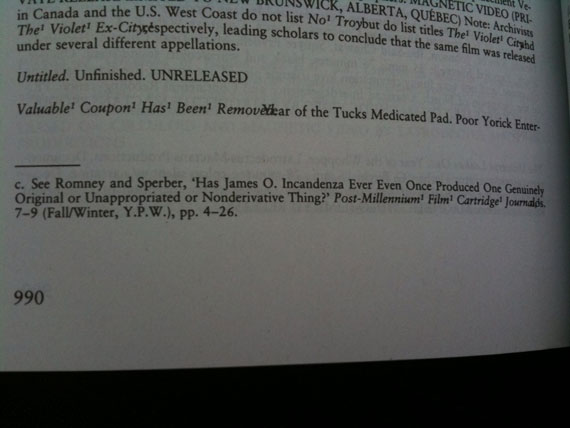
Aphrodisiacal Footnotes and the Impotence of History

James McWilliams - 6.25.2013 | 5
No historian in the history of writing history was writing history in order to get laid. And that’s ultimately why, I’m afraid, we’re history. Our time has come.
James McWilliams - 6.25.2013 | 5
● ● ●

© PWxyz, LLC. All rights reserved.