In 2017, Honey & Wax Booksellers established an annual prize for American women book collectors, aged 30 years and younger. Our goal, at the time, was to expand the popular perception of who book collectors are (and can be) by highlighting original collections built by young women, often without the knowledge or help of the rare book trade. By celebrating their achievements, we hoped to inspire potential collectors to look at their shelves differently, to identify patterns, and to think creatively about the aspects of the historical record they might recognize and preserve.
The response to this prize has exceeded all of our expectations. As we celebrate our tenth and final year, we want to thank all the collectors who shared their projects with us over the past decade. We learned more than we ever imagined from your ingenuity and dedication.
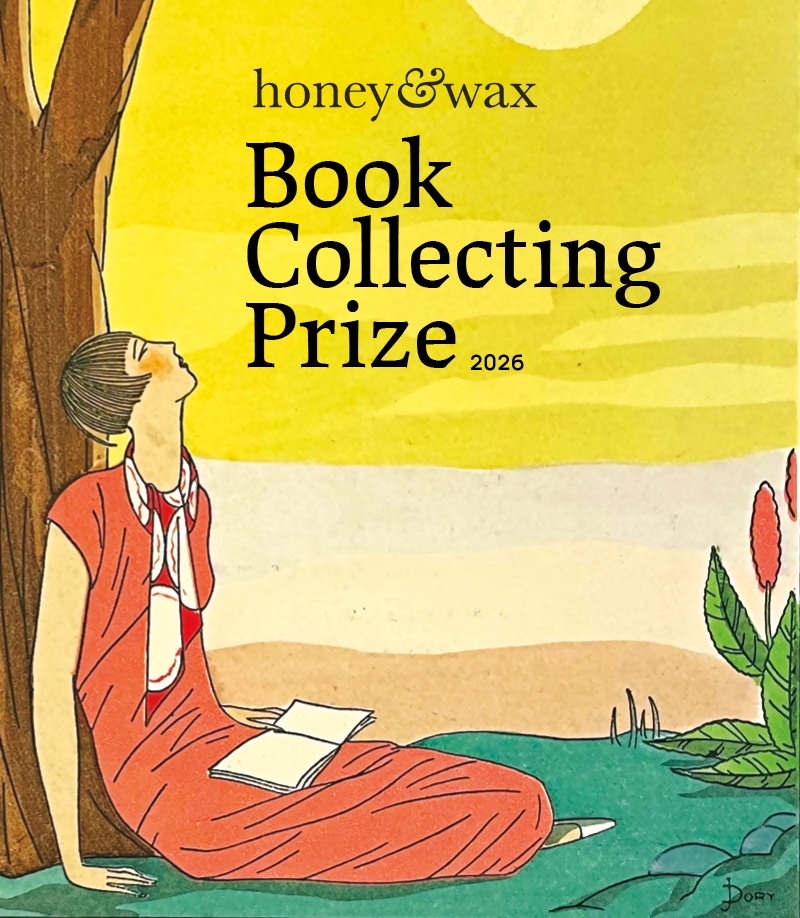
We are delighted to announce the $1000 winner of the 2026 Honey & Wax Book Collecting Prize.
WINNER
Darby Ronning, 25, (she/her), Youth Programs Coordinator at All Souls Unitarian Church in Tulsa, Oklahoma, for “The Alldera Collection: Feminist Science Fiction of the Twentieth Century.”
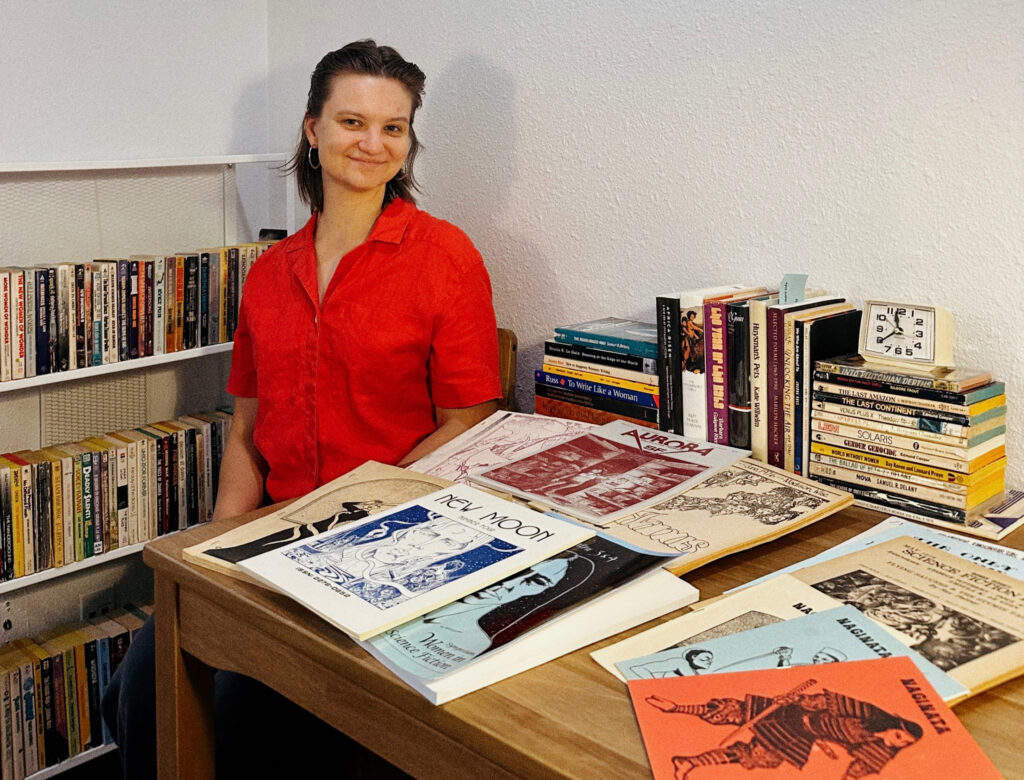
Named after Alldera, the heroine of Suzy McKee Charnas’s decade-spanning series The Holdfast Chronicles, Ronning’s collection documents the various ways that science fiction by and about women was published, marketed, and read in the twentieth century, from pulp paperbacks featuring women in chains to self-published feminist fanzines.
While Ronning’s collection includes some of the most celebrated names in modern science fiction (Ursula K. LeGuin, Joanna Russ, James Tiptree, Jr.), her focus is on lesser-known writers: “I try not to spend more than ten dollars per title – a rule that, by design, sways the collection towards smaller names. These writers were veterinary radiologists and gymnastics instructors, physicians and mothers, and their backgrounds inform their storytelling.” Her commitment is to the wider community of ordinary women reading, writing, and debating science fiction during a period of rapid societal change: “My collection aims to get at this entire ecosystem of imagining alternative worlds.”
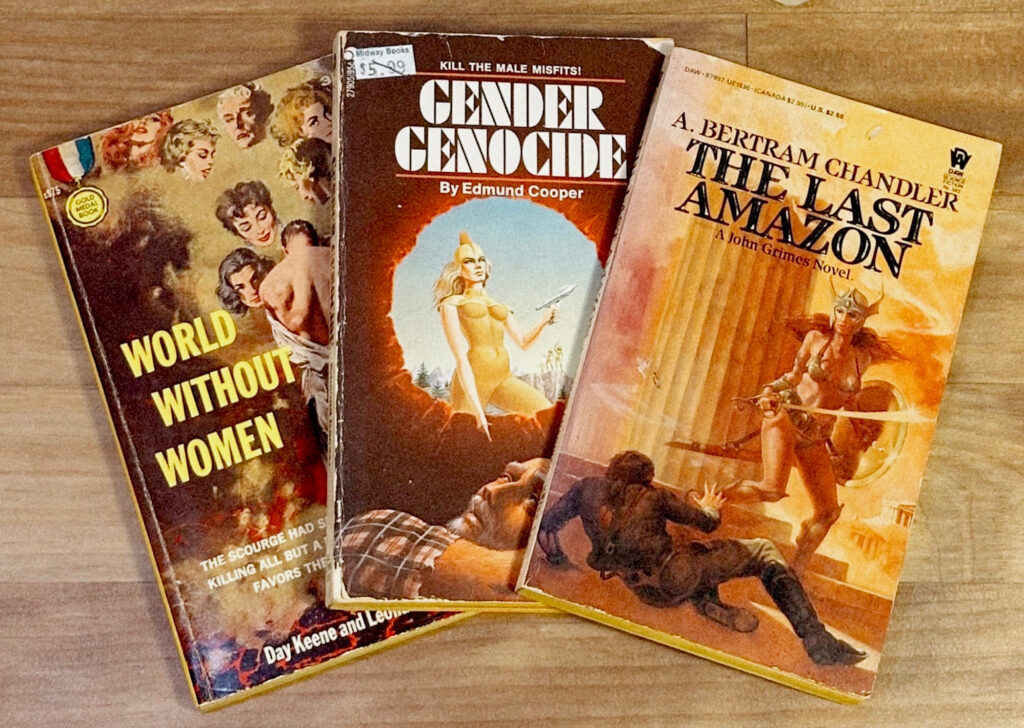
We were particularly impressed by Ronning’s developing focus on the popular reception of the novels she collects: “Science fiction in the 1970s had an active fan culture, and fans connected over reviews, art, and fiction circulated through zines. Janus (later Aurora) was perhaps the best-known feminist science fiction fanzine. . . . The authors themselves were part of this meta-commentary, submitting to fanzines and contributing to scholarship on the movement; several names feature in both fiction and non-fiction sections of my collection. These zines and works of criticism are now my chief collecting priority, because they are the format that best reveals feminist science fiction as a whole. I hunt for titles that are poorly documented and undigitized, keeping a keen eye on eBay. A recent find, New Moon, had ties to the publishers of Janus but took a more scholarly approach; I hope to acquire the other three issues.”
Ronning’s ultimate goal is to share the Alldera Collection with the public through a visual archive and blog: an initiative that reflects the collaborative, independent origin of much of the material she collects.
You can read Ronning’s winning essay and bibliography here.
*
We are also awarding five honorable mentions of $250 each:
HONORABLE MENTIONS:
Juniper Couture, 24, (she/her), an artist, bookbinder, and freelance bibliographer in Tucson, Arizona, for “An Unusual Collection of Miniature Books Formed by a Lady.”
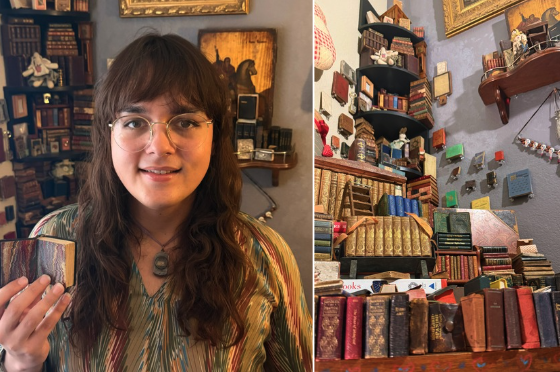
When Couture was a child, her father purchased a set of 1960s-era “Lilliput Dictionaries” for her at their local used bookshop, a gift that sparked a lifelong interest in the secret history of the miniature book.
The “concealable nature” of the miniature book makes it an ideal format for distributing controversial ideas and practical information. Couture’s interest in the social history of her collection ignited a wider curiosity: “No matter how far my research goes, so does the enchantment of little books as they give up new secrets again and again. . . . I came to a wall in my collecting where I could not understand my books fully without learning how they were made, and that has become an equally rewarding practice as collecting.” Couture shares her collecting and bookbinding progress on social media as @thelilliputianlibrary.
We admired the depth of Couture’s collection, which runs to four hundred volumes, as well as the way her antiquarian approach continues to open new fields of inquiry.
*
Maya Fell, 30, (she/her), a graduate student in art history at Hunter College, for her collection “Armed Women Vernacular Photography,” encompassing over one hundred photographs and pieces of print ephemera.
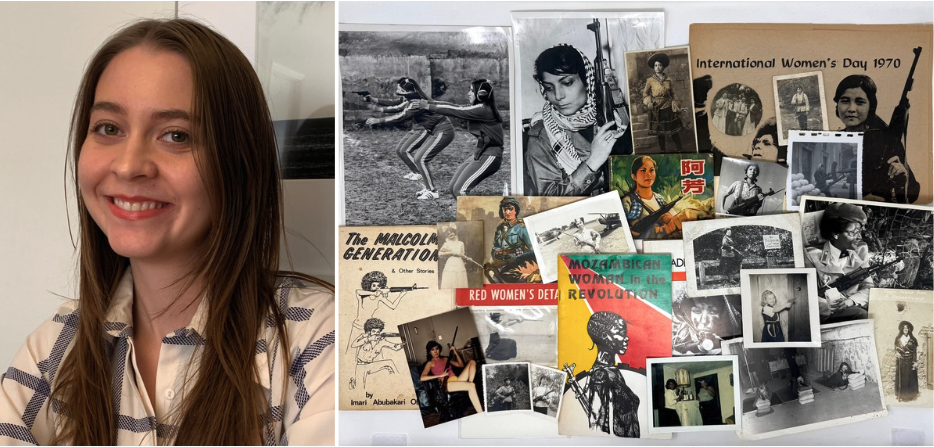
Fell’s interest in snapshots of “the gunwoman” began with the visual culture of the Soldaderas during the Mexican Revolution, but expanded to include “the larger typology of the armed woman in liberation movements globally.”
Fell observes that vernacular photographs of women soldiers and revolutionaries tend to be romanticized and sexualized on the secondhand market: “stripped of names, dates, and locations, they are frequently sold merely for their surface aesthetic novelty.” To recenter the individual subjects in the photographs she collects, Fell “began intentionally pairing the photographic prints with a robust supporting collection of movement-generated print media, including radical newspapers, political pamphlets, and historical leaflets. . . . radical print culture acts as the historical anchor for the anonymous image.”
We appreciated the way that Fell’s pursuit of iconic images of armed women led, through her expanded collecting focus, to a more critical and contextual understanding of the movements they represent.
*
Leila Louhaichy, 28, (they/them), manager of the Hauser & Wirth Gallery Bookshop in Chelsea, for “Opening the Door for a Native New Yorker.”
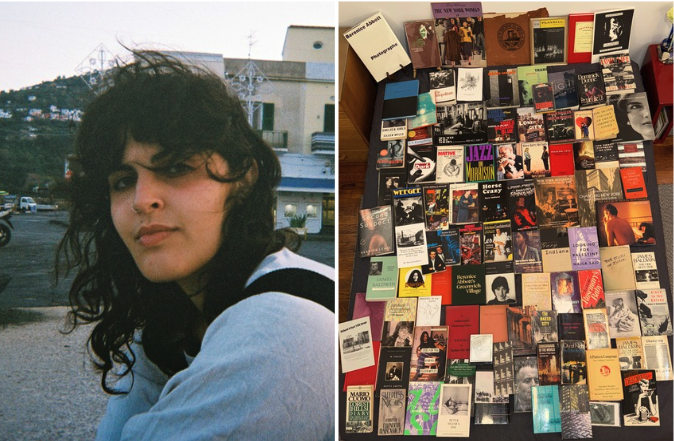
Beginning with the paper trail created by three generations of Louhaichy’s own New York family, the collection originally focused on books about the city’s architectural and social history.
Over time, Louhaichy’s approach shifted, as they placed apparently “incongruous” works in juxtaposition to produce a new synaptic map of the city: “The titles within this collection center New York City as a character, not so much in the anthropomorphized sense, but rather as an expansion of the narrative. . . . New York City is the collection’s overarching theme, but the sub-genres orbiting within it are queerness, working class life, urban aesthetic beauty, focusing on how these subjects interact to weave the fabric of the city’s culture.” Louhaichy’s collection represents a series of unfolding conversations: Jane Jacobs with Samuel Delany, Betty Smith with Paule Marshall, Berenice Abbott with Leslie Feinberg, Bret Easton Ellis with David Wojnarowicz. As @angelbooksnthings, Louhaichy sells used books and shares aspects of their collection on Instagram.
We were impressed by Louhaichy’s sharp bibliographic commentary, which made a convincing case for their collection as more than the sum of its parts.
*
Rose McCandless, 27, (she/her), Instructional Services Coordinator in Special Collections at Ohio State Libraries, for “The Book as Art and Commodity: Design Reform and Commercial Publishing, 1890–1915.”
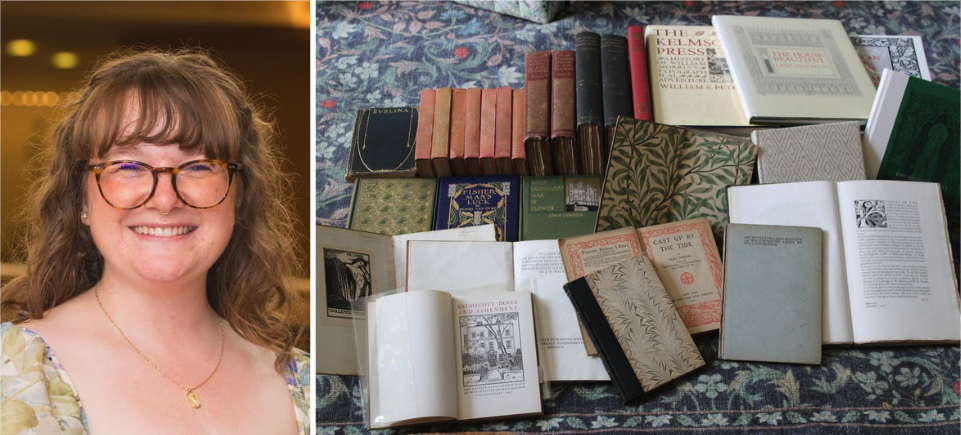
Her collection explores the way that the Arts & Crafts ideal of the printed book as an organic work of art trickled down into mass-produced books for the everyday reader.
While private presses like Kelmscott and Doves produced limited runs of meticulously crafted handpress books for a select readership, “their theories of design exerted a profound influence on commercial publishers seeking to distinguish their books within an increasingly competitive marketplace.” To document this influence, McCandless collects popular series like the Everyman’s Library, whose decorated endpapers and title pages echo Kelmscott’s medievalist design, and Art Nouveau publisher’s bindings that draw on the ornamental and typographic style of the private presses – all while noting the tension between the “handmade” aesthetics of these books and their machine-made production.
We applaud McCandless’s creative pivot: unable to purchase the great private press titles, she found a different way to explore Arts & Crafts publishing history by strategically shifting her focus.
*
Caitlin Paton, 30, (she/her), a certified medical coder and medical coding supervisor in Palm Bay, Florida, for “‘Let Me Be a Little Girl as Long as I Can:’ A Collection of Little Women.”
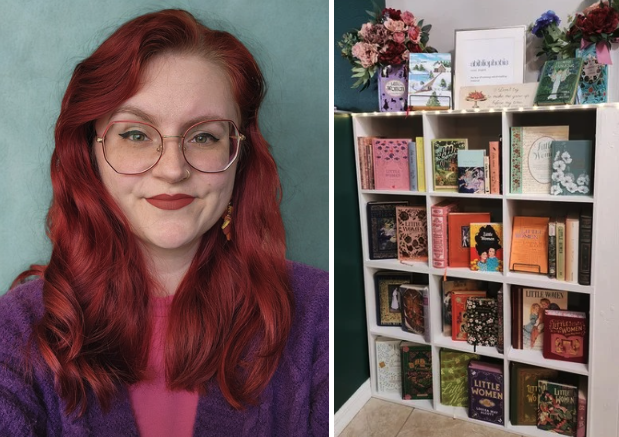
Inspired by her grandmother’s nineteenth-century edition of Louisa May Alcott’s Flower Fables, Paton has collected dozens of editions of Little Women, from an abridged edition distributed free with the purchase of a can of Folger’s coffee to a Penguin anniversary edition with a foreword by Patti Smith.
The dynamics of the close-knit March family are reflected in the building of Paton’s collection, a personal quest that has taken on a social dimension: “I have found my own March sisters in this world. Women who, upon stumbling through a used bookstore, have texted me variations of, ‘Do you have this edition?! I’m getting it just in case!!’” The collection is not only a record of family and friends, but of places traveled and bookshops visited: “Some people collect airport destination coffee cups or monogrammed gift shop keychains, but I love to be able to look at my bookshelves and remember Denver, Estes Park, Maggie Valley, Asheville, Newport, Providence, and hopefully many more destinations to come.”
We enjoyed the enthusiasm that Paton brought to her single-title collection, which reflects the rewards of a targeted approach.
*
The co-founders of the Honey & Wax Prize, Heather O’Donnell of Honey & Wax Booksellers and Rebecca Romney of Type Punch Matrix, would like to thank the 2026 prize sponsors: Biblio, Bibliopolis, Christie’s, and Ellen A. Michelson.
Thanks also to Lit Hub, Antiquarian Booksellers’ Association of America, Fine Books & Collections, and The Millions for their support over this decade-long project.
Most of all, thanks to all the young women who have shared their growing collections with us! We are excited to see where they take you.